Hyperrhiz 30
What You Hold
Victoria Neal
Citation: Neal, Victoria. “What You Hold.” Hyperrhiz: New Media Cultures, no. 30, 2026. doi:10.20415/hyp/030.b02
Abstract: What You Hold is an interactive poem about memory and loss. Letters vanish from the page, and it is the reader’s task to hover over each word to keep it alive. To resist the steady erosion of thought is both easy and hard. Focus is needed, yet one must also learn to let go. In doing so, the poem becomes an abstract theatre of loss, and the physical effort of maintaining even a single thread of consciousness lays bare the mind’s ceaseless labour.
Keywords: E-poems, digital, poetry, memory, attention, interactivity, caregiving, cognition, Alzheimer‘s, art.
Artist‘s Statement
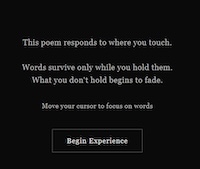
Someone close to me was starting to forget words. And then he started to forget that he had even forgotten. I tried to write a traditional poem about it, but the static page felt unequal to the experience. I felt a need for the reader to witness the fading, moment by moment. That is how What You Hold began. I wasn't seeking to replace traditional poetry, but to try a different path. I wondered if the medium could participate in the feeling, rather than just point toward it.
From the start, making What You Hold accessible shaped key choices during its creation - especially decisions around user engagement that remain voluntary. Black lettering stands sharply against white space, cutting down distractions through deliberate simplicity. Visual extras get left out on purpose, keeping things clear. Performance needs stay modest so more people can use it without strain.
What You Hold is written in standard JavaScript and CSS, less than 16KB. It is for older devices and slow networks. Each word tracks decay. Hovering or touching temporarily brings it back. If not given attention, words diminish at a certain rate. Short phrases disappear first.
Still, the poem works only for certain eyes, minds, or paces of reading. By design, this exclusion forms a core idea. Unequal access becomes part of its structure. For some, the words vanish too fast to finish. Meaning slips away before others can grasp what appeared.
Though text stays readable by design, its rapid vanishing mimics a kind of forgetting people actually endure. Some readers cannot hold onto phrases before they fade. Finishing a line becomes uncertain ground. Unequal demands on attention, persistence, strength - these shape who engages and who slips through. Real struggles with memory echo here, not neatly packaged, never uniform.
The Ending
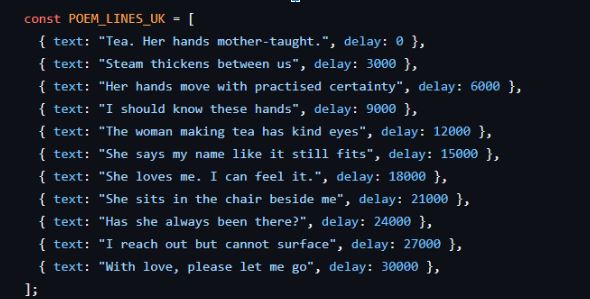
Let go now, Please... let me go, and I'm sorry are the final lines of the poem. A final, light blue message that reads, "Thank you," appears when engagement ends. Even in cases where preservation is unsuccessful, this conclusion recognises attention as an act rather than an outcome.
Seven people tried the poem out - mostly folks close to me - so their feedback might lean favourable. On desktops, things moved smoothly; lines lit up fast, no stops. When switching to phones or tablets, though? Slower rhythm took over, taps grew careful. Fingers didn’t rush, seemed unsure at times. After half a minute, hands sometimes tired. The device held shaped how it felt. What worked one way on screen played differently in hand.
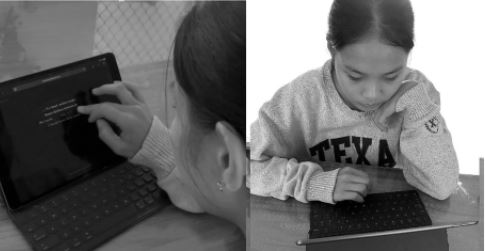
Some thought it went quicker than comfortable. A restless soul swiped frantic arcs, chasing letters doomed to vanish - kept at it a full minute till arms gave out. People reacted in their own ways: folding quick, pushing harder, some convinced a smart move could beat the outcome. Not a single one saved every word. That’s sort of the idea: focus slips, tiredness arrives, losing comes steady like waves.