Hyperrhiz 30
ARE WE NUTS?
Barry Mauer
University of Central Florida
Citation: Mauer, Barry. “ARE WE NUTS?.” Hyperrhiz: New Media Cultures, no. 30, 2026. doi:10.20415/hyp/030.e01
Abstract: This essay, inspired by Gregory Ulmer’s Internet Invention: from Literacy to Electracy, presents a widesite consultation on the super wicked emergent problems of climate change and fascism. While these are deadly serious problems, the method of consultation employed here is quite playful. Pun-related discourses linked to the word “nuts” relate to the author’s “popcycle” of discourses that formed his ideological map. The elements of this popcycle include falling off a bicycle, the Dada artist Kurt Schwitters, a Kurt Russell Disney film, a Swedish children’s story, and George Morikami (a Japanese American farmer interned during World War II). The consultation focuses on water crises in the American West, particularly as they relate to the nut industry. The conclusion focuses on the figure of the shaman: a “half-nuts” figure who can help us navigate our way through crises.
Keywords: Gregory Ulmer, climate change, fascism, shaman, wicked problems.
Introduction

In 1966, one year after my birth, Leroy Pullins released the single “I’m a Nut,” an infectious novelty tune that hit the top 100. I probably heard it on the radio because my first words were “I’m a nut.”
So, if I’m a nut, I need to know what kind of nut I am. This project answers the question “Are we nuts?” in the affirmative, but it also explains why it matters a great deal what kinds of nuts we are. The term “nuts” is hardly clinical; it is a vernacular term meaning “crazy.” When I was very young, I understood “nuts” to mean crazy in a good way – silly, wacky zany – the kind of “nut” that Leroy Pullins claims to be in his song. Later I learned that people could be nuts in a bad way: unreasonable, malicious, and destructive, as illustrated by Cypress Hill’s lyrics from “Insane in the Brain”: “I feel like the Son of Sam / Don't make me wreck shit hectic.” These were nuts to avoid.
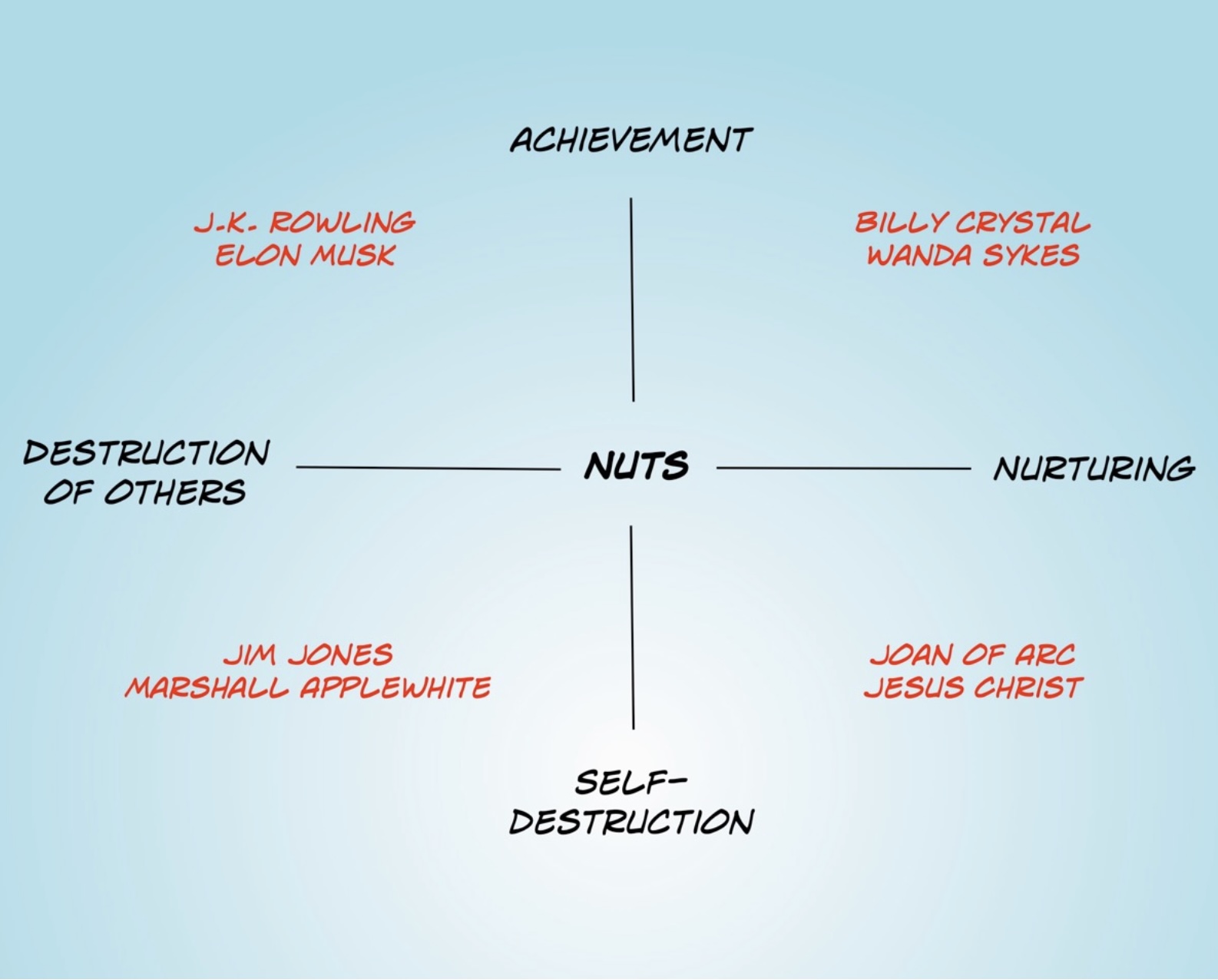
Below is a chart I made showing four categories of nuts. Only one kind – the nuts in the upper right – are unproblematically “good” nuts because they can balance achievement and nurturing. The others are problematic nuts because they destroy themselves and/or others. I grant that in some circumstances, adaptive responses require the sacrifice of self or others, but that it is unproblematic to seek win-win outcomes for self and others (with “others” being defined as inclusively as possible). The people I identify in each category serve the purpose of illustration based on public imagination. Maybe the “real” Billy Crystal is not the same as his public image, but that’s not my point here.
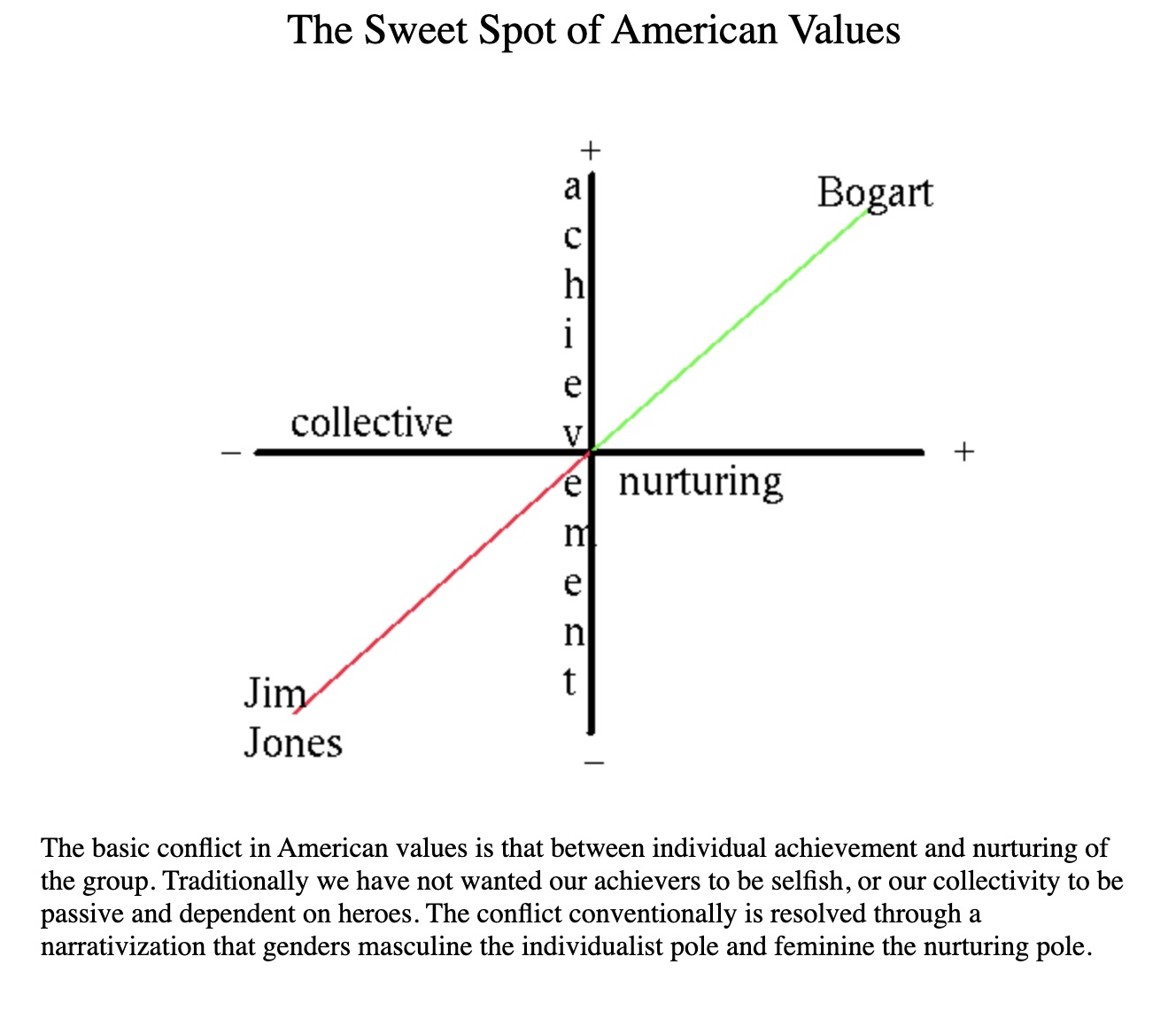
I adapted my graphic from this one by Gregory Ulmer:
What we face in a second Trump administration is a society led by nuts from the upper left corner; these nuts seek gain at others’ expense, and we call these nuts “bullies.” When they are organized and take over the political machinery of a society, we call it fascism. Fascists are aided and abetted by other nuts who debase themselves to merit recognition from the bullies. See example below.

Fascists are trying to block efforts to address climate change. Efforts to address climate change will be stymied until we first remove the block of fascism.
Super Wicked Emergent Problems
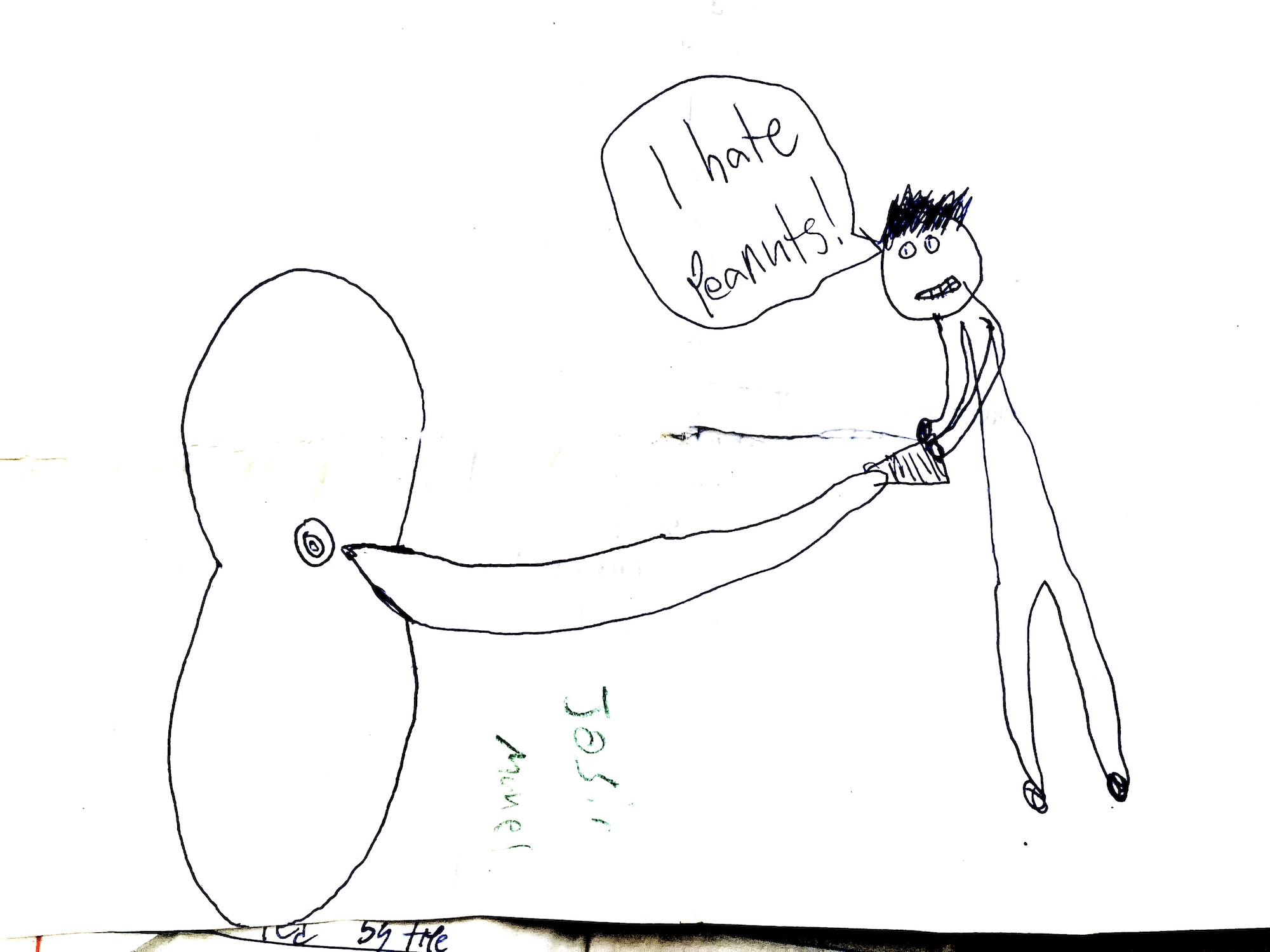
How do we deal with the nuts of fascism and climate change? I see them as emergent wicked problems, and I approach them using Gregory Ulmer’s methodology from Internet Invention, which involves making a widesite. The widesite is a genre of consulting that combines the maker’s Mystory (more on that later) with an emblem that combines an image from the problem domain and a title from the domain of discipline. My image from the problem domain is Mr. Peanut (more on that later) and my title from the domain of discipline is Kurt Schwitters’ Ohne Title (The Hitler Gang).
Emergent problems result from underlying conditions (a water drop cannot make a wave, but millions of drops together can make a wave) and pose immediate danger (emergency). Emergence is “a property which a complex system has, but which the individual members do not have” (Issam Sinjab). Bullies exist at an individual level or in groups, but they do not constitute fascism unless they glom together in a critical mass and become a crashing wave that obliterates the political and legal structures of a society.
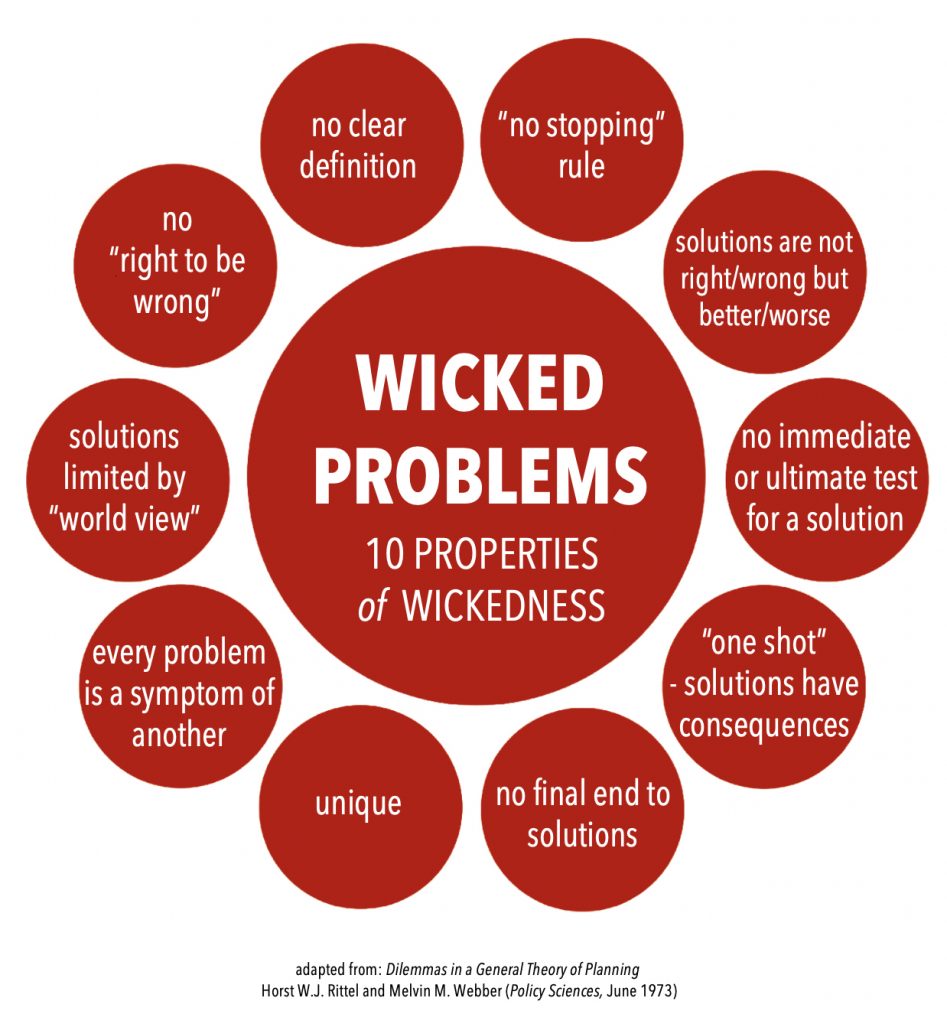
Wicked problems, which are defined by the ten features in the graphic above, include problems affecting the environment (the 6th extinction, depletion of natural resources, climate change), human society (authoritarianism, propaganda, cults), public health (pollution, guns, addiction, vaccine denial), civil rights (degradation of voting rights, reproduction rights, immigrant rights), and the economy (growing inequality, market volatility, externalities). These problems are “wicked” because they resist resolution due to “incomplete or contradictory knowledge, the number of people and opinions involved, the large economic burden, and the interconnected nature of these problems with other problems” (AC4D). All wicked problems relate to the human question, which is the problem of desire. Wicked problems persist as symptoms of human desires, some normal and some aberrant. We want comfort – a normal desire – but our comfort may come at the expense of the environment or human rights. Some human desires – such as the desires to fear the stranger, to place oneself above others, and to depend on a punishing authority figure – are aberrant. Wicked problems feed on our desires.
Kelly Levin, Benjamin Cashore, Graeme Auld and Steven Bernstein introduced the term “super wicked problems” in a 2007 conference paper, which was followed by a 2012 journal article in Policy Sciences. In their discussion of global climate change, they define super wicked problems as having all the characteristics of wicked problems with the following additional characteristics:
- Time is running out.
- No central authority.
- Those seeking to solve the problem are also causing it.
- Policies discount the future irrationally.
Philip Kotler and Christian Sakar define seven wicked problem areas, including
- The death of nature
- Inequality
- Hate and conflict
- Power and corruption
- Work and tech
- Health and livelihood
- Population and migration
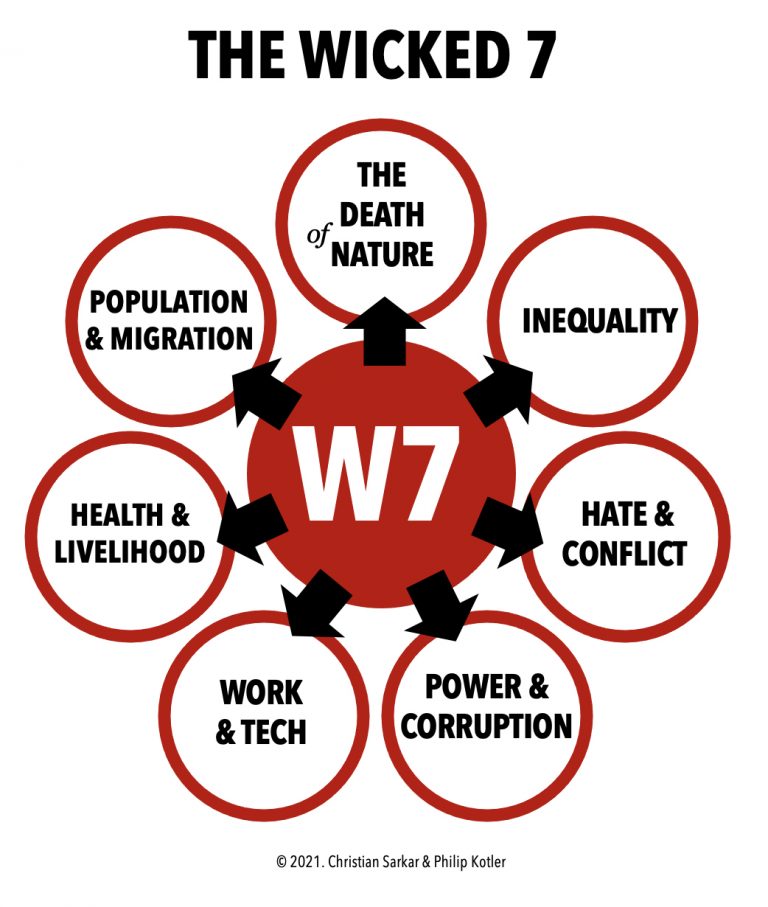
The wicked problem of fascism belongs fundamentally to many categories of the “Wicked 7,” namely inequality, hate and conflict, and power and corruption, but it impacts all the other areas as well.
After a brief overview of Ulmer’s method that follows, I will discuss the ten qualities of wicked problems and the four qualities of super wicked that define the super wicked – and related – problems of fascism and climate change.
Ulmer’s Widesite
The best way to undertake this work is to ask, “What is my relationship to X?” (X is the wicked problem and burning question). The widesite will reveal – or at least intimate – an answer to my question. The method of this work is divination, but we are doing a modernist version. Divination, contrary to common understanding, does not provide a direct answer to a question. Nor does it reveal to us the future. Rather, it poses a riddle about our current circumstances, one that requires interpretation.
The “widesite” is Ulmer’s term for an electronic divinatory emblem that brings together four quadrants of the researcher’s “popcycle” (these include the nurturing authority figures from childhood in the ideological domains of family, school, history, and discipline) with a “burning question” (personal problem) and an “emergent wicked problem” (global catastrophe). The widesite testifies to the values, behaviors, and sacrifices related to the researcher, their burning question, and to the emergent, wicked problem(s). It allows us to diagnose our condition, at both a personal and collective level. The inner portion of the emblem is the “mystory” – a poetic divinatory reading of which leads to a reflective disclosure (epiphany). The mystory should not be understood as a form of self-expression; rather, it produces self-portraits, revealing to us the points of our identification. Ulmer calls these points our premises: “the inventor’s ideological premises do not determine in advance the outcome of the process but constitute the field, place, diegesis, or chora of its genesis” (2005, 84). By adding the wicked problem and burning question to the emblem, the mystory becomes a widesite.
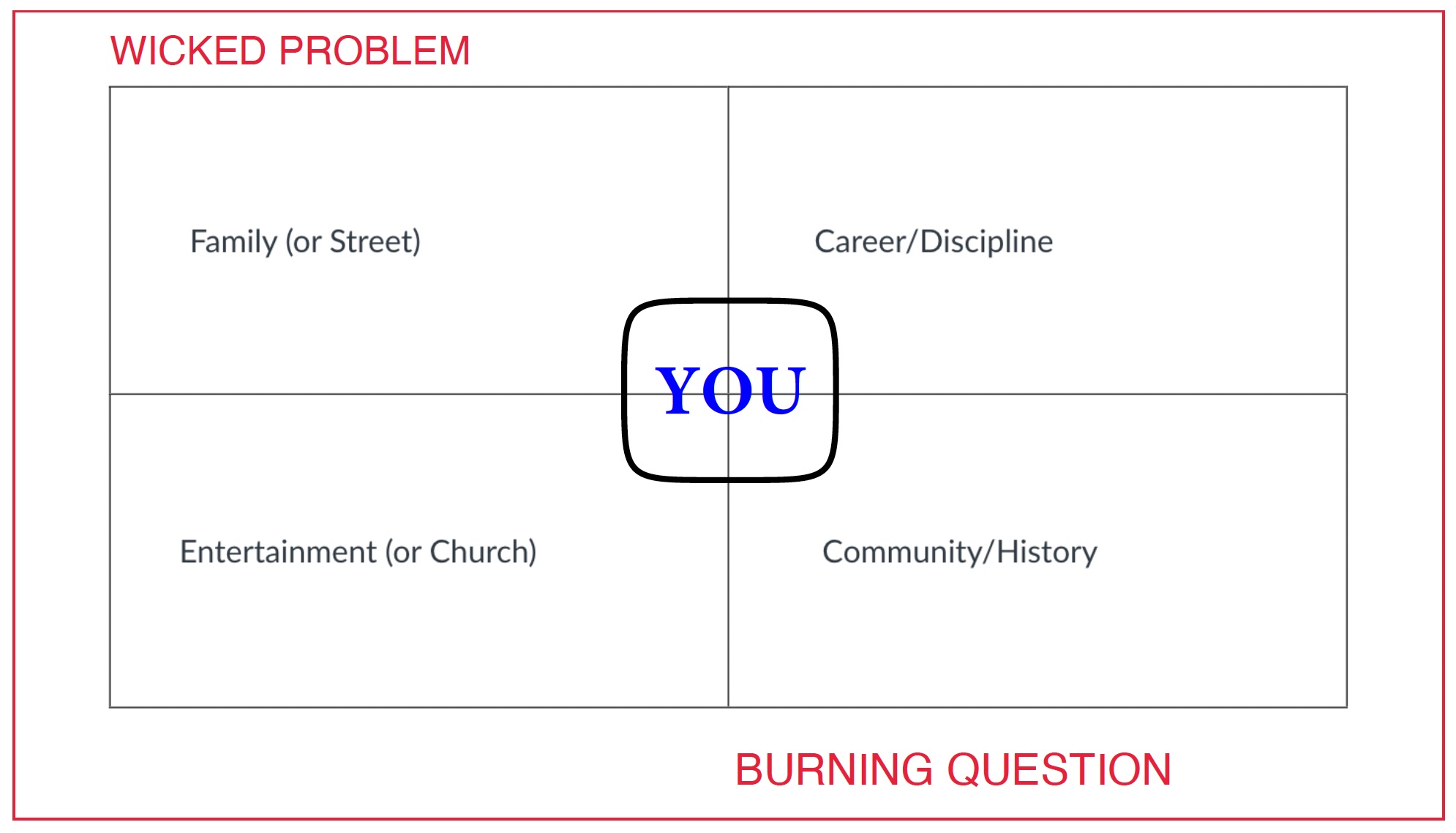
The “popcycle” is so named to reflect how ideas and texts circulate through major institutions – family, school, entertainment, the disciplines – and facilitate further discovery and invention. Ulmer’s popcycle extends Louis Althusser’s theory of interpellation, which explains how people come to occupy subject positions (such as producers/consumers, teachers/students, clergy/laity, bosses/workers, etc.) and assume the habits and social relations pertaining to these positions. The popcycle accounts for the ways in which each institution appropriates texts used in other institutions to serve its own purposes, which include the perpetuation of the institution, the reproduction of its practices, and the subject formation and reproduction of social relations necessary to uphold it.
Conventional – non-divinatory – consulting has demonstrated the dangers posed by fascism and climate change, the many factors that contribute to them, the difficulty in addressing them, and the severe consequences that result from failure to adequately address them. These conventional consulting methods include those of political science, climate science, energy production and consumption, agriculture, and many others. The goal of such consulting is to use reason to preserve the wellbeing of human and other life on the planet while causing the least amount of damage to the economy, human health, etc.
Such expert knowledge is crucially important but insufficient because it is rarely holistic. More importantly, it assumes a rational human subject capable of properly responding to this information when human beings are primarily led by desire (even rationality results from a desire). Ulmer’s method is not opposed to conventional methods. Rather, it focuses on the unconscious dimension: the realm of unreason. What are the desires that drive climate change? For instance, do societies have a desire for their own destruction? To answer such questions, we include evidence and logic that aren’t part of conventional public policy consulting, but rather come from everyday life, psychology, sociology, and the avant-garde arts. To distinguish his methods from conventional consulting, Ulmer uses the word “konsult.”
Ulmer writes, “The oracle at Delphi does not reveal or conceal, but intimates.” He refers here to a kind of truth that differs from concepts of truth developed under alphabetic and print literacy. In alphabetic and print literacy, at least in the western tradition, the proposition is either true or false. So, “the dog is awake” can be checked by observing the dog. In the pre-literate cultures of ancient Greece, and the post-literate culture of electracy that Ulmer is discussing, propositions are less about an objective state of nature and more about “second nature (genius, that is, human creativity, cultural productivity).” Ulmer’s study is more about our relationship to the state of things in nature rather than about the state of nature solely. About this relationship we can only “intimate.” Ulmer provides an example of this “intimate” logic in the poetry of Theodore Roethke: “[i]t is the logic X = Y. The gardening greenhouses of Roethke’s childhood = X. He shows us the scene (‘Scurry of warm over small plants’) and suggests ‘that is me’ (Y, the unknown).” It is a metaphor in which both sides of the equation are mysterious.
Fascism, Climate Change, and the Problem of Desire
I consult here on the related emergent super wicked problems of fascism and climate change in what Naomi Klein and Astra Taylor call “end times fascism”: “The forces we are up against have made peace with mass death. They are treasonous to this world and its human and non-human inhabitants.” Because fascism and climate change are too broad to address in in any detail, I narrow my focus to the story of David Bernhardt, a corrupt Secretary of the Interior during Trump’s first term. Bernhardt changed water rules to favor big farmers in California; the rule change was opposed by environmentalists because it further endangered already endangered species. Prior to his time in government, Bernhardt had been a lobbyist for the same farmers. His conflicts of interest led to him being investigated for ethical violations. One of major crops of these clients was nuts, particularly almonds, though the linked story highlights a cashew farm.
Burning Question
A burning question is urgent (like a house on fire). Here we select a personal issue, one that we might take to a counselor (or a psychic). Burning questions concern things like relationships, money, career, education, location, living situation, troubling habits, etc. A burning question might be: after my bachelor’s degree, do I go to graduate school or start a career? If I go to graduate school, which one? Note that this work does not require anything confessional; no dark secrets need be revealed. The burning question, like the public policy question, is also a dilemma – any choice you make may close off another choice. My burning question is to address my responsibility as a parent. Or rather, to ask, what is my relationship to parenting? Though my daughter is now an adult, my identity as a parent is complicated by the following questions: what is my responsibility for overshoot (when consumption outstrips nature’s ability to replenish itself), and what is my responsibility for my daughter in a world facing climate catastrophe?
Reading the Super Wicked Problems of Fascism and Climate Change
Horst W.J. Rittel and Melvin M. Webber first defined wicked problems in their 1973 work, “Dilemmas in a General Theory of Planning.” The authors identify ten characteristics of wicked problems. Below I discuss each – as well as the four additional features of super wicked problems – as they relate to the problem of nuts and the corrupt former Interior Secretary, David Bernhardt:
- There is no clear definition of this problem because it involves human desires; nuts are healthy and delicious. We want them. Farmers want to grow them because they make money. Almonds are California’s top agricultural export, bringing in about $5 billion a year.
- It has no stopping rule, in that abuse of power can only be reined in by accountability, which cannot occur when abusers, such as David Bernhardt, have sufficient power to stop it.
- Solutions are not right/wrong but better/worse. The problem with growing nuts is that there are few climates that are suitable. Almonds require a Mediterranean climate - 80% of the world’s almonds are grown in California. California farmers changed the rules of the game for agriculture by growing normally “seasonal” crops all year round. They do this by cultivating desert areas, which requires a lot of water. But the California crop requires huge amounts of (scarce) water. One almond grown in California requires an average of 12 liters. Cashews are tropical and most of the world’s supply are grown in impoverished places such as India, Ivory Coast, Vietnam, and Tanzania. Human rights abuses are common in their production, and they have been labeled “blood cashews.”
- There is no immediate or ultimate test of a solution to this wicked problem. California, like much of the western US, is becoming environmentally unsuited to human habitation and industry, largely due to lack of water. The water shortage is driven mostly by climate change, which is driven mostly by carbon fuels and by agriculture! 80% of the water used in California goes to agriculture.
- Every solution to a wicked problem is a “one-shot operation”; if we shift away from nut farming in California, then we will rely more on nuts from places that have greater human rights abuses. Of course, California farmers have been accused of human rights abuses as well.
- Wicked problems do not have an enumerable (or an exhaustively describable) set of potential solutions, nor is there a well-described set of permissible operations that may be incorporated into the plan. The water problems in the west are intractable. “California, for example, has issued five times more rights than the mean volume of river water available.” “Solving” the problem would require shutting down large areas of agriculture production, which would be economically disastrous.
- Every wicked problem is essentially unique. In the West, “most state and federal governments have taken a regulatory approach to water governance, specifically the prior appropriation system managed by state governments in the Western US. Under this system, state governments hold the water in trust and issue rights to use water to individuals, companies, water utilities, electricity producers, irrigation districts, and other water users.”
- Every wicked problem is a symptom of another problem. The mega-drought in the West is linked to climate change.
- The solutions are limited by “world views.” The choice of explanation determines the approach to the problem’s resolution. Do we explain this problem in terms of consumption and desire? health and wellbeing? money and inequality? the environment? corruption in politics? labor and production? hate and conflict? Each frame shifts the approach.
- The social planner has no right to be wrong (i.e., planners are liable for the consequences of the actions they generate). The falling water levels at Lake Mead illustrate the problems. “It’s very bad,” Campbell said. “There’s no way to mince words about this … if we’re going to save the functionality of Hoover Dam and Glen Canyon Dam, there’s going to have to be, by necessity, a significant decrease in demand on the river.”
Super Wicked Characteristics
- Time is running out. Drought and heat are increasing. Devastating wildfires are causing massive damage across the state.
- No central authority. Water usage is governed by states, federal agencies, interstate agreements, local water districts, and tribal water rights, which are frequently at odds with one another.
- Those seeking to solve the problem are also causing it. The Conference of the Parties (COP) conferences have been implicated in the slow response to climate catastrophe. The negative impacts of climate change and corrupt actors upon the Western United States has pit activists fighting for environmental justice against activists fighting for economic justice.
- Policies discount the future irrationally. The large-scale nut farmers in California, and the corrupt officials who collude with them, prioritize short-term gains over long-term consequences.
In this microcosmic view of nut farming in the West, we see a reflection of the macrocosmic picture of impending global catastrophe.
Problems B Us
The motto of the EmerAgency, Ulmer’s research agency, is “Problems B Us.” It reminds us that Ulmer’s “konsult” is not that of the traditional consultant. In the traditional consult, an expert – standing apart from the problem – says “here’s the problem and what we need to do to fix it.” In a konsult, a person (not necessarily an expert) looks at the problem and says, “this problem is in me; I can’t change it unless I change myself.” The strategy is to poetically map the external problem into the internal identity, which done through the modernist poetics of collage and juxtaposition. The konsult is primarily an image-based strategy, with the poet’s understanding that pictures can also be made with words. Another way of explaining poetry is that it is a kind of metaphorical algebra. A relates to B as C relates to D. In other words, poetic metaphor is not as much about people and/or things as it is about the relationships between people and/or things. There is no way to make sense of relationships except by analogy to other relationships.
Why is the slogan of the EmerAgency “Problems B Us”? The partial answer is that Ulmer was inspired by the marketing of Kids R Us. “Problems B Us” is the appropriate slogan because the problems of the world are not something “out there.” The causes of the world’s problems are connected to larger forces – for instance, of desires – and we find them in microcosm in ourselves. The EmerAgency researches and consults on problems, or obstacles/blind spots/aporias. The EmerAgency is a portmanteau: it combines two words: Emergency and Agency. Agency is straightforward; it is a group of people organized within an institution that is charged with doing something. For example, the US government has the Defense Advanced Research Projects Agency (DARPA), which “serves as the central research and development organization of the Department of Defense.” Emergency refers to the immediate problems facing us, such as climate change. Also implied by the word EmerAgency is the word “emergence.” The problems we face are emergent in that they arise from new conditions (our technologies and their unintended consequences). Finally, the word starts with E, as in electronic, electracy (Ulmer’s word for the era that is overcoming the era of print literacy). Ulmer also draws on the history of the avant-garde, which had research agencies, such as the College of Sociology and the Situationist International. The EmerAgency is an avant-garde research institute that anyone can join (no membership dues required). Its role is to consult on wicked problems. In the EmerAgency, there are “egents.” Ulmer contrasts the work of egents to that of traditional consultants. In the EmerAgency, egents see themselves as the objects of knowledge, not to “objectify” the self but to understand the self as a mystery we need to better understand. The catastrophe is the subject since it already “knows” something more the object (us) than we do.
Extimacy
The literate model of self-knowledge is introspection: looking inside to see how one’s mind and emotions work. The electrate way, by contrast, acknowledges “extimacy.” Extimacy, a term coined by Jacques Lacan, indicates that the inside is out – in our habitus – and the outside is in – we internalize the superego figures and social structures around us. Ulmer cites the poet Bashō, who understood extimacy poetically when he encouraged us to learn to pine (to suffer loss) from the pine (tree).

I adapt this sentiment by learning to nut from the nut (acknowledging that most nuts are not nuts; peanuts are legumes and cashews are drupes). Having children contributes to overpopulation and climate change. It also exposes our children to the emergent catastrophe. We got where we are by nuttin’.
Mauer Mystory
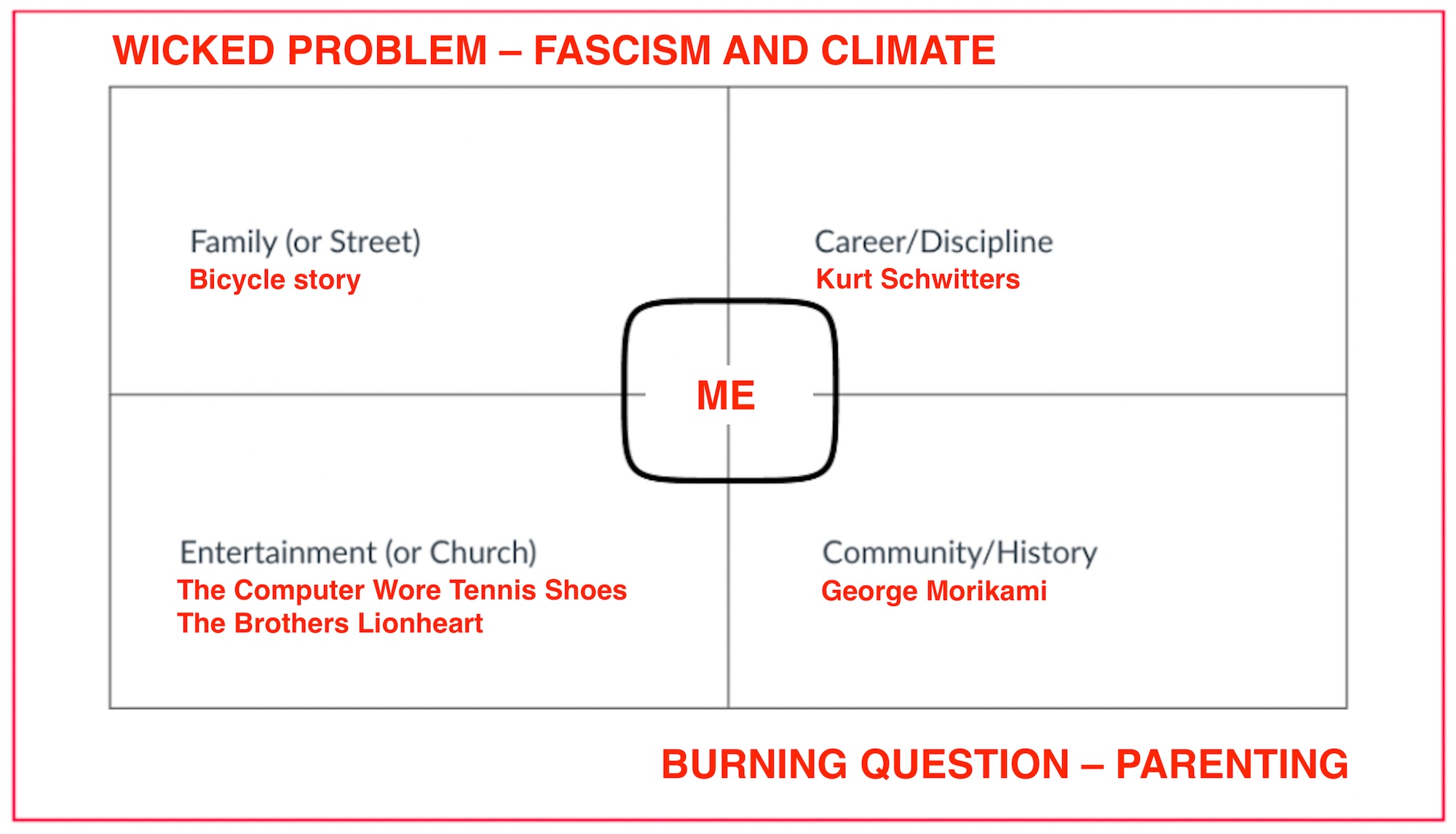
The Mystory is constructed with sacred raw materials, but these materials belong to the personal sacred and not the official sacred (associated with church and state). Michel Leiris explains that the personal sacred consists of
objects, places, or occasions [that] awake in me that mixture of fear and attachment, that ambiguous attitude caused by the approach of something simultaneously attractive and dangerous, prestigious and outcast – that combination of respect, desire, and terror that we take as the psychological sign of the sacred.
He further states that the personal sacred is not
whatever is of gravest importance to me, most sacred in the ordinary sense of the word, at its summit. Rather, it is a matter of searching through some of the humblest things, taken from everyday life and located outside of what today makes up the officially sacred (religion, fatherland, morals) (24).
The sacred is “exactly the point at which I know I am no longer moving on the level of the ordinary (trivial or serious, pleasant or painful) but rather have entered a radically distinct world, as different from the profane world as fire from water” (24). The place to look for the sacred is in childhood, when we were more in touch with the sacred world. As we get older, we tend to lose contact with it (unless we are like the artists and poets who make continual effort to live within and with it).
Family Quadrant: Bicycle Story
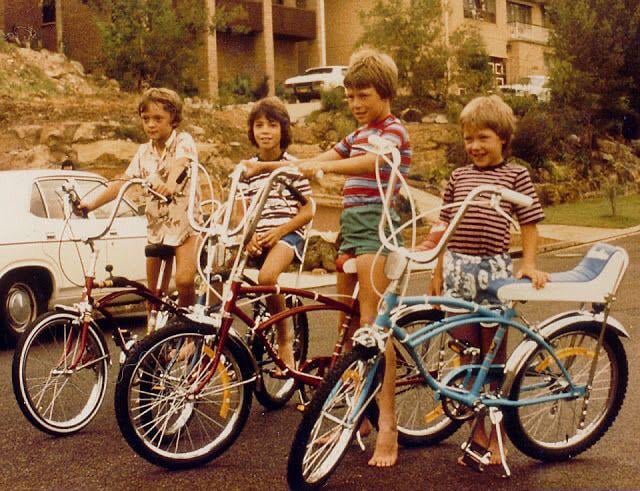
I am a kid of about 8. I am on a bike ride with my little brother and my friends in Roseville, Minnesota. I have a green bike with the wide handlebars and a banana seat. I fall off the bike and land in a ditch by the road; my head hits a rock. My friends’ reactions seem completely overblown: “we’ve got to get you home!” “I’m fine,” I insist. They leave my bike there and walk me home, holding my arm. Other people join in, like a caravan. When we arrive at my house, my mom opens the door, turns white and starts shrieking. I say, “what? I feel fine.” There is a mirror inside the door, and I finally see myself. The left side of my face is under a sheet of blood (only the eye is not covered in blood), and the right side has not a drop of blood on it. I am aghast and start crying. Turns out it is a minor cut, but as my dad later said, the head bleeds a lot.
There was something about this incident – not just that I gave everyone a scare and caused concern – but that it was a kind of rite of passage, like a ceremony – the blood everyone saw but me, a procession, the revelation. My thought: did being all bloody yet staying cool give me a kind of street cred? Was it a red badge of courage or was I seen as a hapless and clueless dork who can’t stay balanced on a bike and doesn’t even know he’s bloody?
My dad is a pediatric nephrologist. Many of his patients died because they lost their kidneys. More than once, I found him devastated after losing a patient – like he lost one of his own children. He struggled to accept that he lacked the power to save them all.
Exercise: Family Album
I’ll describe a few photos from memory. In one, I am about 6 years old, and I am with my little brother. We are in empty railroad boxcars. The photos are black and white. My dad took them. He was practicing his photography (he had a nice camera and was learning the technical skills of fine art photography) while gathering photos for family archives. My brother and I look similar but not identical – the resemblance between us is strong: like the Beatles in their early photos. We both have mops of blond hair. Mine hangs straight while my brother’s pokes up here and there. My expression is determined while my brother’s is soulful. My brother and I are both wearing long pants, but no shirts. We look intense, slack, intimate, distant – a whole collection of contradictions. If we had been 15 years older, these would have been great photos for a band. The photo that has the most power for me was taken inside the boxcar. I am holding the door and looking out at the train yard.
Exercise: Micro Scenes
Like most children, I was fascinated by power. As a child, I understood power as physical strength, like the kind superheroes had. I was small and skinny for my age. My friends and I often walked through our suburban neighborhood, ending at the creek or each other’s houses. One day, a friend brought an older boy who seemed strange and quiet. My friend tells the older boy to show us how strong he is. As I watched with utter amazement, he grabbed a street sign by the post and lifted it out of the ground, pulling the concrete anchor and piles of dirt up with it. Later, I tested my strength on a different street sign. It didn’t budge.
Entertainment Quadrant: The Computer Wore Tennis Shoes, The Brothers Lionheart
Ulmer asks us to recall an entertainment story that provoked a strong emotional reaction. In the instructions for this exercise, Ulmer writes in Internet Invention:
- The first purpose of the documentation is to record the part of the story that you remember. Once you have inventoried the remains of the work in your memory, view it again (if it is available) and record what you notice in this fresh viewing. The memory is the site of a sting, in Barthes’s sense. You are looking for the obtuse meaning of a story - a personal association with some detail in the narrative.
- The second aspect of the memory work is to connect your Family memories and the Entertainment narrative. The connection will most likely not be literal, but figurative. The Mystory forms what Roland Barthes called a “structural portrait”: the relationship between you and the narrative is that of a proportional ratio. Your position in your family is analogous to the position of the character to his/her diegetic world. The idea is to map one story onto the other. The entertainment narrative figures the atmosphere or mood of the family situation, not its literal circumstances. (127)
Here I recall two stories: one I encountered in early childhood and the other in puberty. Both are liminal ages – transition points in which old identities are discarded and new ones adopted. The right “scene of instruction” at the right time will rewire one’s identity, usually in ways that the subject dos not fully understand.
The Computer Wore Tennis Shoes

My mother took me to see The Computer Wore Tennis Shoes, a Disney live action film, when it was released in 1969. Wikipedia summarizes:
While installing a replacement computer part during a thunderstorm, Riley receives an electric shock and becomes a human computer. He now has superhuman mathematical talent, can read and remember the contents of an encyclopedia volume in a few minutes, and can speak a language fluently after reading one textbook. His new abilities make him a worldwide celebrity and Medfield’s best chance to win a televised quiz tournament with a $100,000 prize.
During a competition, Dexter gets a question about apples (note: the fruit around the cashew seed is called an apple – more about that later), which triggers a glitch in his programming; he is possessed by the computer and spits out a strange code that implicates a gambling gang. Dexter starts performing someone else’s program; he goes “nuts.”

The Computer Wore Tennis Shoes previewed for me what being an intellectual meant. It activated my desire to be one. The film equates intelligence with being a human computer. It gave me an anticipatory identity: this is what I will be like in college.

When I reviewed the movie recently, I noticed the sets are populated with famous paintings, including Duchamp’s Nude Descending a Staircase and Whistler’s Mother (the actual title of which is Arrangement in Grey and Black No.1). The artwork represents a different kind of intelligence.

I am now more interested in the knowledge represented by the mood conveyed in these paintings than by computer generated answers to trivia questions. Here I see a mismatched encounter between Entertainment and Discipline (Arts). Both Dexter and Duchamp are nuts of the upper right – balancing achievement and nurturing. But Dexter is possessed by a program while Duchamp is channeling and shaping the spirit of the age.
The Brothers Lionheart
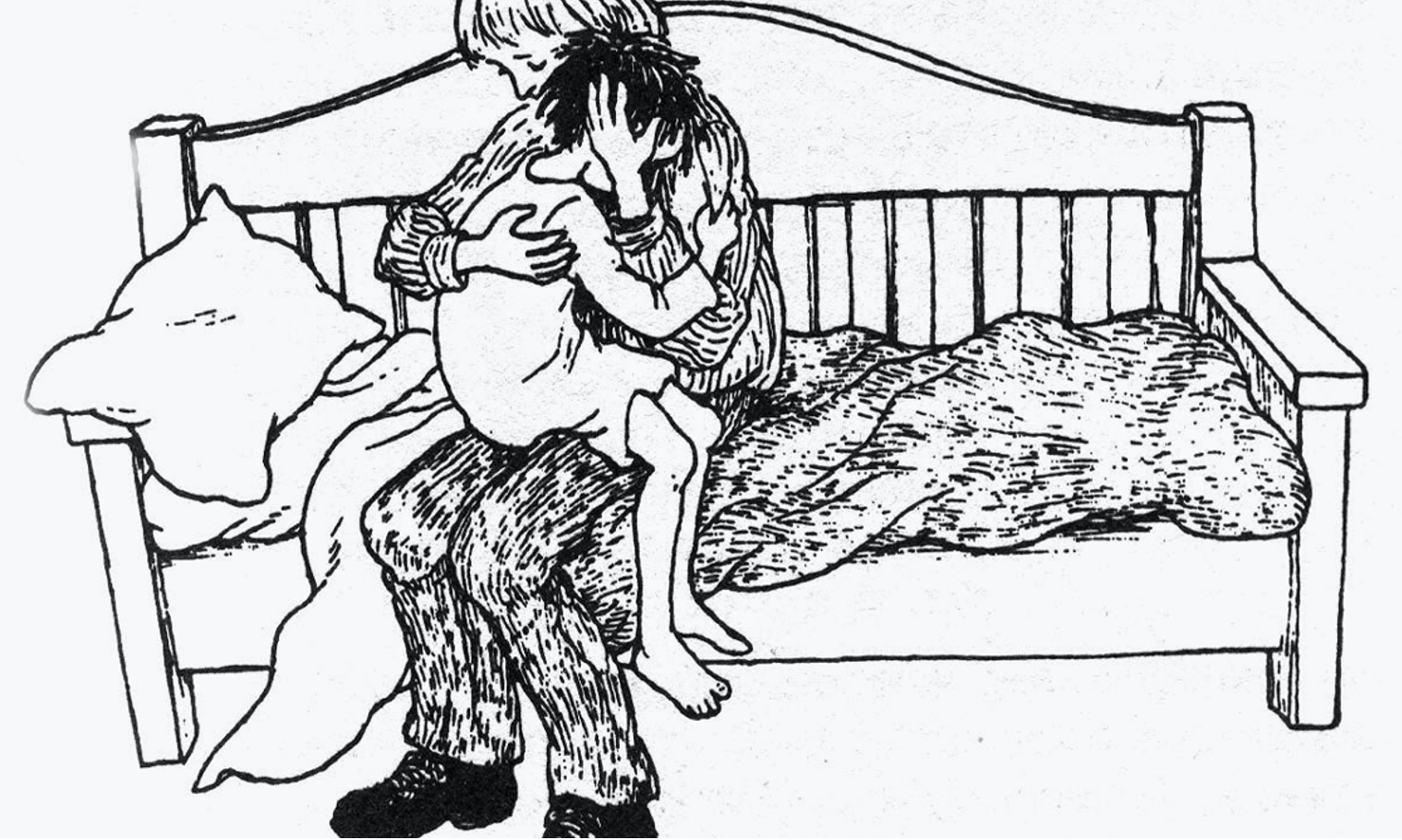
In The Brothers Lionheart, a children’s book, a healthy boy, Karl, sacrifices himself during a fire to save his little brother, Rusky, who is dying of tuberculosis. Karl models heroism. Rusky, meanwhile, feels like “a little piece of filth.”
Before Re-Reading
When I searched my memory about The Brothers Lionheart, I couldn’t recall the author’s name. My mother had read the story to me when I was 12. My younger brother and younger sister were there as well. Here’s what I remember about the story –
It grabbed me immediately with its title – I imagined it was about medieval knights – and with its opening: two brothers, approximately the ages of me and my brother, but the younger one was dying. The older brother told the younger that when he died, he was going to a beautiful place (it wasn’t called heaven in the book), that his body would be restored, and that he only had to wait a little (time would go very quickly in this place) until he, the older brother, would be there with him and they could play in full health and happiness.
With their plans made and the younger brother fearless of death, tragedy strikes the family; the older brother is killed in an accident, dying before the younger brother. I remember crying upon hearing this and trying to hide my sobs from my mom and siblings. The story continues with the younger brother feeling lonely and lost and trying to bravely face his impending death without his brother, but he soon dies and is indeed reunited with his older brother in this beautiful place, and indeed his body is restored. I cried more at this turn of events with a sob of joy mixed with pain. There was a lot more to the story – these events take place within the first quarter of the book – but I don’t remember the rest.
The Ulmer assignment tells us to apply the Entertainment story in a figurative way to the family “problem.” But the first thing to note is the literal similarity. Neither my brother nor I were dying. But we were close in age, and we did suffer, and sometimes I believed that dying would be a relief. Our parents had moved the family from Roseville – a suburb of the Twin Cities – to south Minneapolis. The move wrenched us from our friends and coincided with me entering junior high, being small for my age, and being picked on by bullies. It was the first time since I was in 2nd grade that my brother and I went to different schools. It felt like the separation of the two brothers that occurred in The Brothers Lionheart.
Though I came to appreciate Minneapolis for having a vibrant arts culture that Roseville lacked, I first went through the ordeal of loneliness and alienation in a strange and hostile place. I dreamt of a better place, like the heavenly Nangiyala in The Brothers Lionheart.
Re-Reading Brothers Lionheart
I note that the author is Astrid Lindgren (I had imagined a male author), and that she is Swedish. It was published in 1973, four years before I first encountered it. Wikipedia notes: “Disease, death, tyranny, betrayal, and rebellion form the backdrop of the story, against which are contrasted platonic love, loyalty, sacrifice, hope, courage, and pacifism.” The story is narrated by the younger brother, Karl (nicknamed Rusky). The family’s last name is Lion, and the story is about how Karl’s brother became Jonathan Lionheart.
The boys’ father went to sea and never come back. This detail pricked me since my father was a busy doctor who was gone most days. On the first page of the story, Karl recounts how he learned he was dying by overhearing a conversation he wasn’t meant to hear. Karl shares this news with his brother Jonathan, who tells him about a place in the afterlife called Nangiyala. The brothers keep Nangiyala secret, which reminds me of Michel Leiris’s “personal sacred” and how he and his brother invented stories about their toilet serving as a link to the underworld. Ulmer’s exercise calls for detail about the characters’ gestures; Karl coughs and Jonathan sits on the edge of his brother’s bed and tells him stories.
When Jonathan tells Karl that death is nothing to fear because they would both go to Nangiyala, Karl makes a fateful pronouncement: “‘Just think how good it would be if you’d gone there first,’ I said, ‘so that it was you who was sitting there fishing.’ Jonathan agreed.” The opening is very concise. In chapter 2, which begins on the fifth page, Karl reports the story of Jonathan’s death by citing a newspaper article about it; the boys’ building had caught fire, and Jonathan had put Karl on his back and thrown himself from the window, killing himself while cushioning Karl. Why would a healthy boy sacrifice himself to save a dying boy?
Jonathan’s self-sacrifice earns him the name Lionheart. While in school, the boys had read about the English King, Richard the Lionheart. Richard the Lionheart was like Columbus: either a hero or mass murderer depending on your perspective. The boys’ teacher, memorializing Jonathan, closes with these words: “The gods love those who die young.”
Karl learns that everyone wished he had died in place of Jonathan. He recalls Jonathan’s final words: “Don’t cry, Rusky. We’ll meet in Nangiyala.” He reports, “no one could possibly long for someone as I longed for him.” Jonathan comes to Karl’s window in the form of a pigeon. This scene had been foretold in the previous chapter by a song the mother sings about her lost husband:
If I die at sea, dear perhaps there’ll be a day when a snow-white pigeon comes from far, far away then hasten to the sill, dear it’s my soul that’s there, wanting to rest a while, here in your arms so dear.
Jonathan tells Karl that they have their own farm in Nangiyala and that he should hurry and meet him there. Karl learns that his name will be Lionheart too. Karl soon dies, after leaving a note for his mother telling her not to cry because she’ll be with them in Nangiyala too. The boys had not shared anything about Nangiyala with the mother until this point.
Once in Nangiyala, Karl discovers that he doesn’t cough anymore and that he can swim without effort. For me, this point is where the story should have ended. Plots unfold in Nangiyala, but why should I care about battles in an afterlife?
The central question: why value a boy who is broken and dying, especially if you must trade the life of a healthy boy to save his? The answer is that their value lies in brotherhood, not in individual personhood. When I undertook this exercise, I faced a major loss, but my brother was spiraling and unreachable. I felt like Karl without Jonathan before the pigeon came. My daughter then explained her interpretation of the story; the whole Nangiyala plot is just Karl’s fever dream before he dies.
When I was 12 and my mother had reached the point in the story when the boys arrived in Nangiyala, I started crying and excused myself to hide my tears. Therefore, I didn’t know that at the end of the book, Jonathan becomes paraplegic from wounds received in battle and asks Karl to kill him so he can go to the next place: Nangilima. The boys never die because they just get new bodies in new places. The ending could be read as a cop-out that avoids dealing with the finitude of life.
But if the story is not about eternal life but rather the fantasy of eternal life, then it is less trivial. If Karl is having a fever dream about Nangiyala before dying, the story is profound because it demonstrates the power of belief. In the grand finale, Karl plans to put the paralyzed Jonathan on his back and jump off a cliff, reenacting the earlier scene in which Jonathan saves Karl by jumping out of a burning building with his brother on his back. But he hesitates, saying to himself, “Well, if you don’t dare now, I thought, then you’re a little bit of filth and you’ll never be anything else but a little bit of filth.” This is not the voice of courage but the voice of shame. The suicide cult appears; to live is to escape shame by dying with and for your beloved.
Exercise: Sender and Receiver
Ulmer:
Do an analysis of your Entertainment narrative in terms of sender and receiver. Try to describe the value/power working in the diegesis, using the form of premise and central idea. How does the dramatization prove the premise? Relate the premise to the ideological categories of identity you noted in your Family story.
Nangiyala seems to promise fulfillment with little effort. But even there, one’s default state is to be in deficit – a bit of filth – unless one rises to the challenge. And rising to the challenge doesn’t just happen once; it must happen repeatedly. Karl believes he is a bit of filth and that he must overcome this deficit. His smallness, weakness, and brokenness reinforce the sense of worthlessness he feels. We are meant to identify with Karl’s desire to be more than a bit of filth, like the heroic Jonathan. Jonathan is the sender and Karl the receiver of heroic values.
The story rests on the premise that the default state is to be a “bit of filth,” as reflected in the passages below:
- Couldn’t he just as well stay at home by the fire at Knights Farm and enjoy himself? But then Jonathan said there were things you have to do even if they are dangerous. “Why?” I asked. “Otherwise you aren’t a human being but just a bit of filth.”
- The hours went by; perhaps I would be sitting there still, if I hadn’t suddenly remembered what Jonathan had said – that sometimes you have to do things that are dangerous; otherwise you weren’t a human being but a bit of filth. So I decided. I banged my fist down on the rabbit hutch so that the rabbits jumped, and I said out loud so there would be no mistake. “I’ll do it! I’ll do it! I’m not a bit of filth.”
- If I find him, I thought then. But if I didn’t... Then my courage ran out of me all at once. I was a little bit of filth again, a scared little bit of filth, as I’d always been.
- “Why did you save that man Park’s life? Was that a good thing?” “I don’t know whether it was a good thing,” said Jonathan. “But there are things you have to do, otherwise you’re not a human being but just a bit of filth. I’ve told you that before.” “But suppose he’d realized who you were?” I said. “And they’d caught you?” “Well, then they would have caught Lionheart and not a bit of filth,” said Jonathan.
- “Well, if you don’t dare now, I thought, then you’re a little bit of filth and you’ll never be anything else but a little bit of filth.”
Karl and Jonathan are nuts of the lower right-hand corner; they sacrifice to escape shame.
History Quadrant: Roosevelt and Morikami
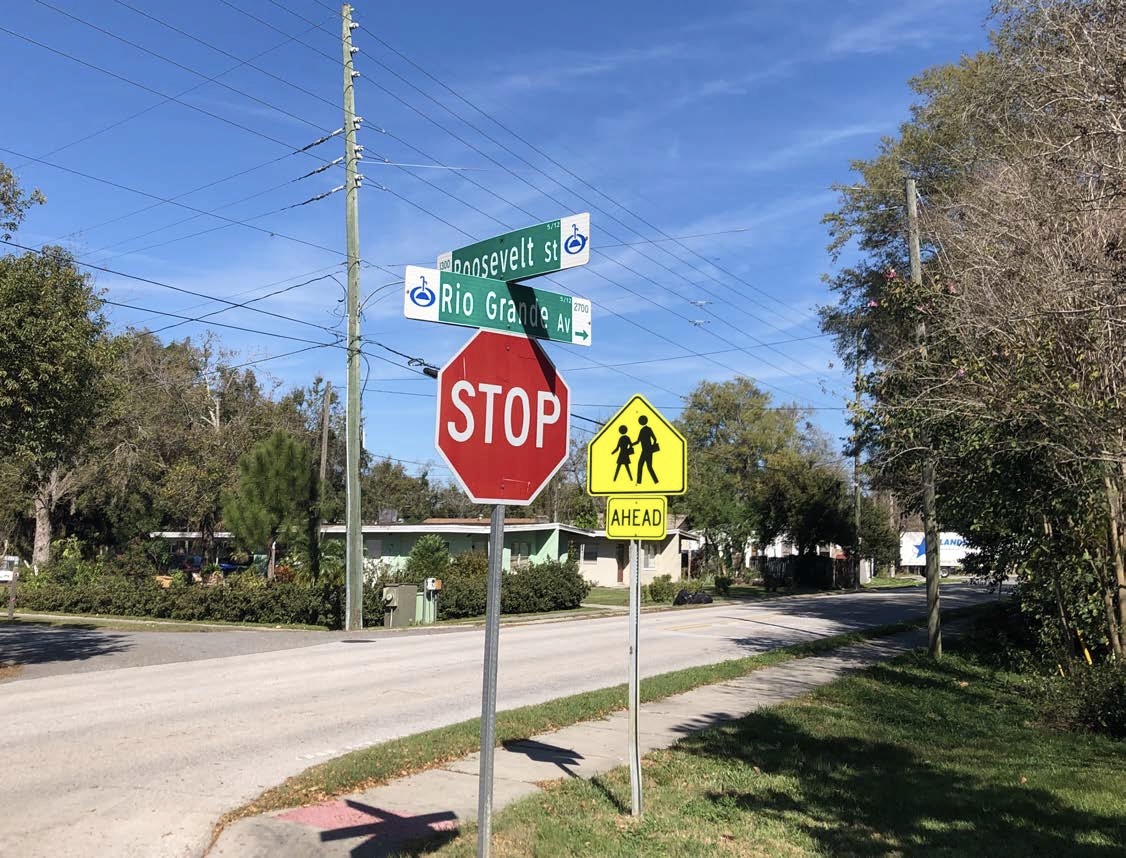
Ulmer asks us to explore a public monument and reflect on its values. The Roosevelt Street and Rio Grande Avenue signs – at an intersection in the College Park neighborhood of Orlando where I lived for 20 years – constitute two monuments. The streets in this neighborhood are named for colleges and universities, though there are no actual colleges or universities in it (I was misled!). But there is a Roosevelt University in Chicago, named for Franklin and Eleanor. Its website states: “Roosevelt University is a national leader in educating socially conscious citizens for active and dedicated lives as leaders in their professions and their communities.” Rio Grande Avenue is named for a private university and public community college in Rio Grande, Ohio. The town was named, inexplicably, for the river that makes up much of the USA’s southern border. Trump and his supporters pushed to build a wall on this border by claiming there was a national emergency. A school crossing sign appears on my street corner, reminding me that the lessons of US history (presidents and borders) belong to the apparatus of school. My house was within walking distance of four K-12 schools.
Franklin Roosevelt’s great achievements recognized that collective problems required collective solutions. He spoke to the nation through fireside chats. These chats, in their thoughtfulness and intimacy, were the opposite of Hitler’s harangues. The first part of Roosevelt’s last name sounds like “Rose.” There is a Rose Valley in The Brothers Lionheart. I grew up in Roseville, Minnesota. The anti-Nazi resistance group at the University of Munich was called The White Rose. Franklin promoted Rosie the Riveter to enlist women to join the war effort. “As was his wish, Roosevelt was buried on April 15 [1945] in the Rose Garden of his Springwood estate.” To me, Franklin Roosevelt was more important than Teddy Roosevelt because he was more recent (he was president when my parents were born) and he guided the nation through the depression and World War II.
We face risks of economic and political catastrophe today, with additional threats of climate change, nuclear war, and mass extinction. Under Franklin Roosevelt, the US became a superpower. Roosevelt took a nation defeated by the depression and turned it around through mobilization, with rationing a sacrificial act.
But Roosevelt’s military was segregated, he signed the Japanese Internment Act, imprisoning hundreds of thousands of Japanese Americans in concentration camps, and he opposed anti-lynching legislation.
Roosevelt is not my focus, however. I am looking for a ficelle in his story. Ulmer writes,
The formula for the syncretic project of electracy is to locate the ideological other [who is] quilting or suturing (‘sutra’) together one’s cultural point of view, and then switch the dominant focalization (usually so familiar that one does not even experience it as such) for an unfamiliar one associated with the ficelle. (195)
The ficelle is a character, seen initially as marginal, who represents an alternative set of values. We shift focus by making the ficelle our protagonist.
Sukeji “George” Morikami
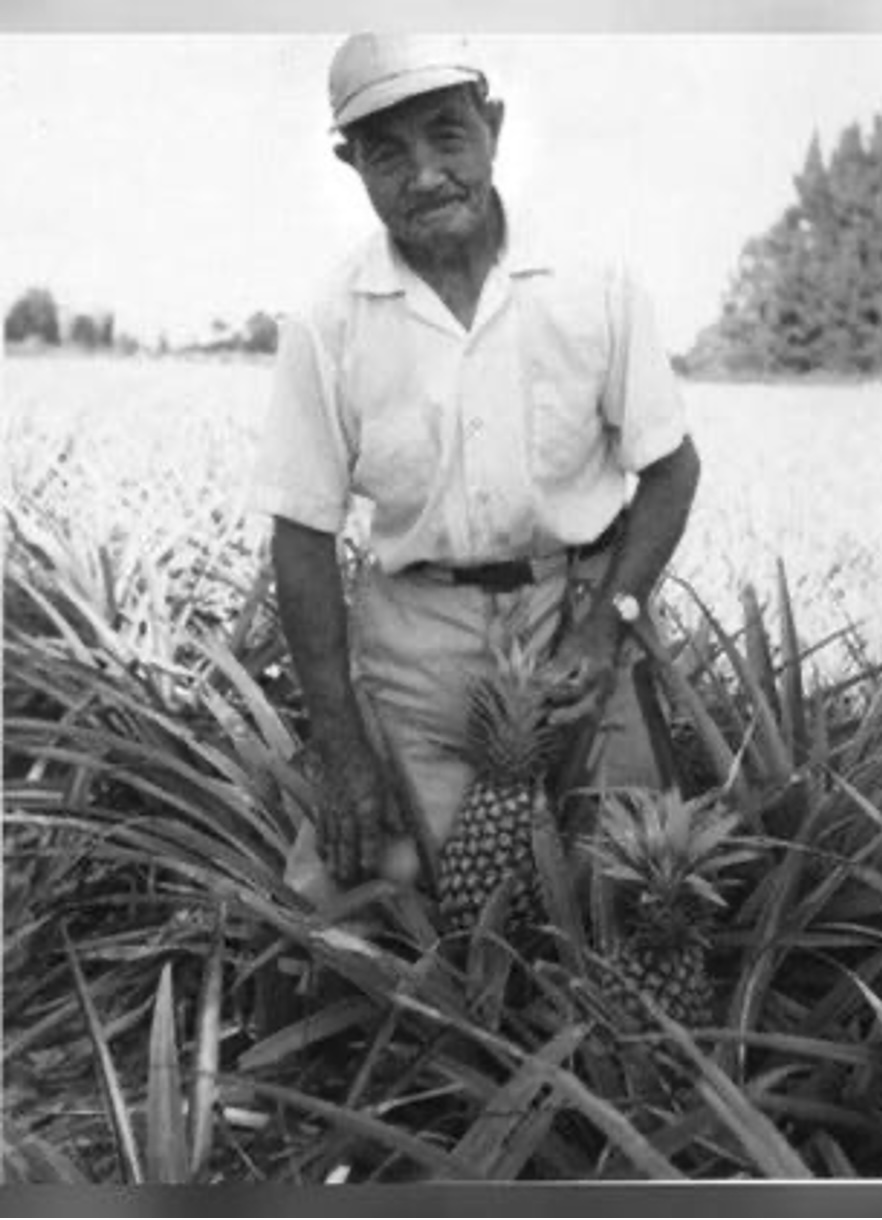
Sukeji Morikami was a Japanese American who was interned by Roosevelt, his property being seized to create an Army Corps training base. After the war, Morikami bought land in Delray Beach, Florida, and farmed it for 30 years. He donated his land upon his death, and the Morikami Museum and Japanese Gardens is now open to all people. Morikami was a settler who left Japan with Jo Sakai, the leader of the Yamato colony, a group of about 15 men, which was established in Boca Raton in 1905.
From “His Little Mount Fuji Wealth of Memories” by Jerry Schwartz:
George Morikami, Japanese expatriate, landowner and 89-year-old pineapple farmer, lives in a drab, yellow trailer perched on a miniature levee he built himself and calls Mount Fuji ... He is one of the last surviving members of Palm Beach County’s Yamato colony, a settlement of Japanese families lured to the United States at the turn of the century with hopes of many dollars to be made farming in a rich new land. Thursday the Del Ray Beach Kiwanis Club honored Morikami forgiving 40 acres of land for a county park, but the frail farmer, who has been in failing health, was unable to attend his own testimonial. George Morikami has journeyed far for his honor. “I came here in 1906. I was the only one of my people who was uneducated. They were all educated. I couldn’t speak or write English,” Morikami says ... The Yamato colony failed. The pineapples grew well but the Japanese could not compete with the low prices asked by the Cubans. Most of the farmers left. Morikami stayed ... Though his life is simple, it isn’t without its small luxuries. Dr. James Winchester, a former University of Florida agriculture professor who has known the old man for years, estimates there are more than 40 varieties of fruit trees and decorative plants on Morikami’s land. “He built the lake years ago and he plans to plant Japanese pine trees all around it. It’s his ambition to live long enough to landscape it, and the way he’s going, I wouldn’t be surprised if he does,” Winchester said. Morikami intends to keep his money on paper as deeds in the county clerk’s office. “The land is not for sale at any price,” he says. And then a man who is worth more than one million dollars looks out over an unweeded pineapple patch: “All I have now are my memories.”
I recall that pines have nuts: pine nuts. Morikami was a nut of the upper right who persisted in the face of setbacks that would have destroyed most ordinary people. Furthermore, he left a legacy that benefits anyone who visits his gardens.
Career Quadrant: Kurt Schwitters


“My name is Kurt Schwitters… I am an artist and I nail my pictures together.”
Ulmer asks us to address the problem of “home”: making your way in the world even if it’s not a “good fit.” In the early-1930s, Schwitters transformed his family home in Hanover into a livable artwork called “Merzbau.”

Merzbau was the name Schwitters gave to the assembled living spaces that he made for himself in at least four different dwellings. The word “merz” came from a fragment of paper Schwitters found; it is the suffix of the word “kommerz,” or commercialism.
From The Warth-Mills Project:
Part of the Der Sturm group and associated with the Constructivists and the Dadaists, Kurt was interested in challenging traditional modes of artistic representation and production. In 1919, he announced his own, one-man art movement that he called ‘Merz’. Its aim was to combine all forms of creative endeavour and blur traditional boundaries. He produced prose, poetry, typography, painting, sculpture, collage, assemblage and installation. In the early-1930s, Kurt transformed the interiors of the family home in Hanover into a living work of art – an epic undertaking called ‘Merzbau’.
From Wikipedia:
Schwitters: “In the war, things were in terrible turmoil. What I had learned at the academy was of no use to me and the useful new ideas were still unready.... Everything had broken down and new things had to be made out of the fragments; and this is Merz. It was like a revolution within me, not as it was, but as it should have been.”
The story that touched me the most about Schwitters concerns his time in an internment camp in the Isle of Man in 1940:
At least in the early days of the camp’s existence (UK, 1940), there was a shortage of art supplies which meant that the internees had to be resourceful to obtain the materials they needed: they would mix brick dust with sardine oil for paint, dig up clay when out on walks for sculpture, and rip up the lino floors to make cuttings which they then pressed through the clothes mangle. to make linocut prints. Schwitters’ Merz extension of this included making sculptures in porridge.
Fred Uhlman in his memoir:
The room stank. A musty, sour, indescribable stink which came from three Dada sculptures which he had created from porridge, no plaster of Paris being available. The porridge had developed mildew and the statues were covered with greenish hair and bluish excrements of an unknown type of bacteria.
I am moved by the efforts Schwitters made to create a “home” wherever he was – a form of resilience – no matter how poor the conditions, and to include whatever was in the environment, even possessions and pieces of his friends:
These included socks of Moholy-Nagy stolen as he slept, a lock of Hans Richter’s hair obtained in the same way. Others honoured in this way were Mies van der Rohe, Mondrian, Arp and Lissitzky. Among the grottos we know existed were: the Goethe cave, the Nibelungen cave, there were caves of murderers, deprecated heroes, hero worship and friendship. As the merzbau developed grottos were often covered by the geometric facade. Some were locked in permanently while others were accessible through doors or hatches. The Merzbau continued to grow as Schwitters worked on it until December 1936 when he fled the Nazis. When it was left he said it was unfinished and that in principle it could continue indefinitely. Schwitters never returned to Germany and the Merzbau was destroyed in a bombing raid on the night of October 8-9th 1943. Schwitters worked on the Merzbau for thirteen years. In that time it moved from a dadaist starting point to, stylistically, a constructivist conclusion. It can not be considered only as a finished work of art, the process is obviously crucial too.
Schwitters’ Merzbau is a defense, a shell. A head is a nut. Testes are nuts. Testosterone is implicated in increasing the intensity of feelings, including rage (but also nurturing). The following passage describes Schwitters’ poetics:
Schwitters’ early assemblages are so very different from Cubist collages that this analogy is soon exhausted. From 1917, Schwitters’ preoccupations came increasingly to center on creating a vocabulary of pictorial expression to which any kind of referential space structure (such as was retained in Cubist collage) was irreconcilable. The precise chronology of his development into assemblage is not easily fixed. The three “Abstractions” discussed show an increasing sophistication from one to the next (and their order is confirmed by Schwitters numbering these works), but, generally speaking, Schwitters’ course to Merz was most erratic. A sensitive, totally abstract drawing of 1917 seems, for example, amazingly advanced in its intuitive order when compared to a conventionally Expressionist figurative work of 1918. Already implicit in the earlier drawing was the possibility of an autonomous space created neither from the analysis of perception nor by the synthesizing of conventional deductive signs but (as Schwitters was to put it) from the “relationship of form to form, surface to surface, line to line, regarded in a nonaccumulative sense,” that is, by an all-over “continual intersection” of formal devices.
The “relationship of form to form, surface to surface, line to line, regarded in a nonaccumulative sense,” an effect of juxtaposition, is the primary method Gregory Ulmer uses for his work with the Mystory and Widesite.

The title of this work, The Hitler Gang, relates to a fragment of text in the work: an advertisement for a film by that name that was released in 1944. Schwitters was a nut of the upper right. Like Morikami he faced tremendous setbacks yet persisted in his vision to construct his lived environment. Also, like Morikami, he left a legacy that benefits all.
Divining the Mystory
The “nut” repeats in all the quadrants of my Mystory –
- I conked my nut when I fell off my bike.
- Dexter’s skull is a shell that houses his computer brain in The Computer Wore Tennis Shoes.
- Dexter goes “nuts” at the competition when he hears the word “apple.” The fruity part of the cashew is called an apple.
- In The Brothers Lionheart, Jonathan turns into a pigeon. Pigeons will eat peanuts and other nuts.
- General McAuliffe, one of Franklin D. Roosevelt’s generals during World War II, replied to the German demand to surrender with the word “Nuts!”
- George Morikami, Japanese American, was interned by Roosevelt during the war, and later planted pines (which produce pine nuts).
- Kurt Schwitters built his Merzbaus as contained spaces, like nuts in the shell. Dada was associated with absurdity – nuttiness.
What does the nut have to do with parenthood in an age of overshoot? To understand the connection, we need to learn more about the nut from the nut.

Nuts, Climate Change, Bullies, and Water Shortage in the U.S. Southwest

NASA’s satellite images show water levels in Lake Mead plummeting over the last 22 years.
We now face the prospect of a 40% shortfall in freshwater supply by 2030, with severe shortages in water-constrained regions. And fundamentally, as the science and evidence show, this mismanagement of water has pushed the global water cycle out of balance for the first time in human history. We have breached the planetary boundaries for water that keep the Earth’s system safe for humanity and all life.
Who is responsible for the shortage of freshwater in the U.S. West? The causes are various but one of the causes is bullies.
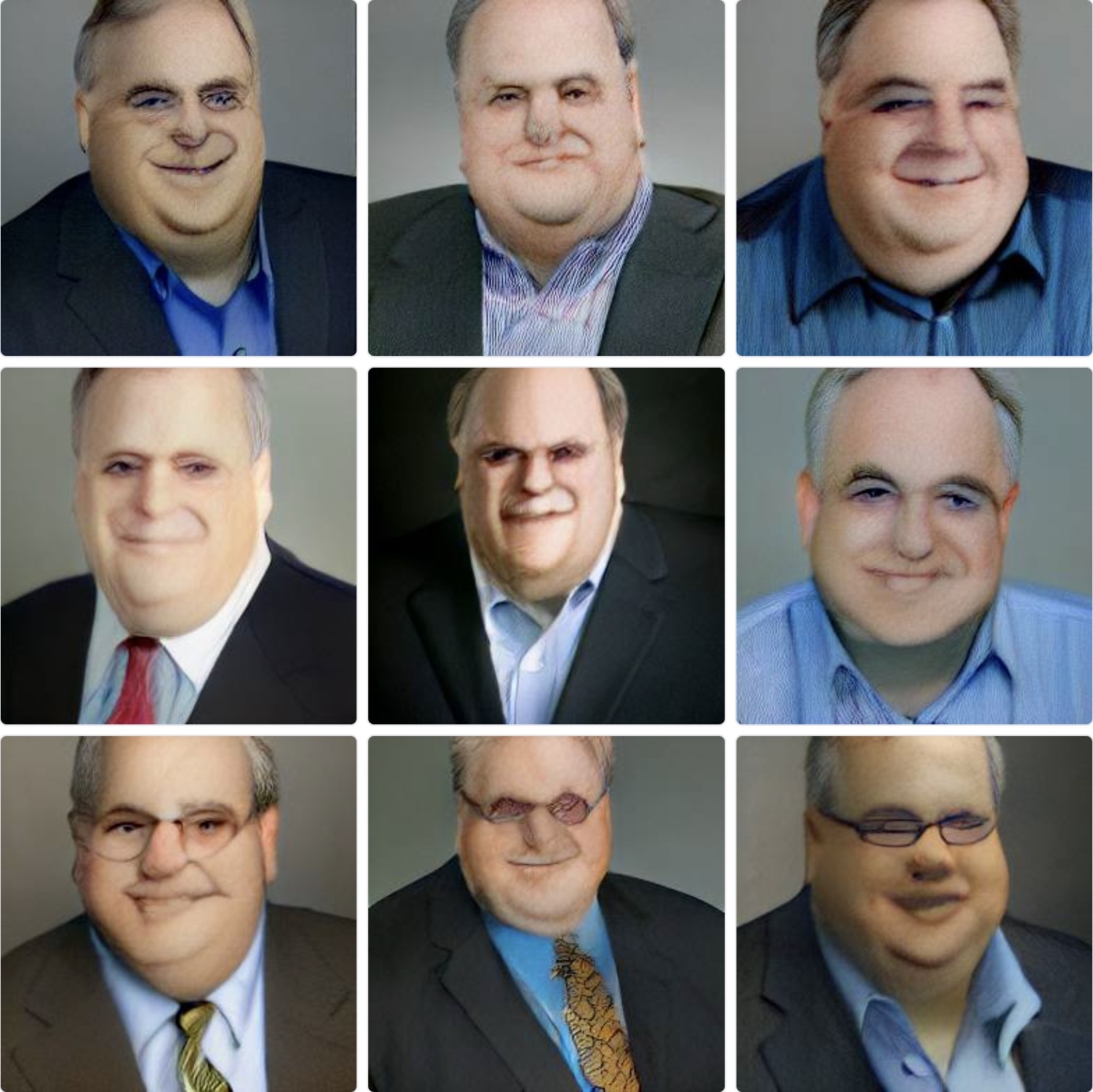
David Bernhardt is one. “We said all along that David Bernhardt was too compromised and too corrupt to be a Cabinet secretary,” stated Jennifer Rokala, executive director of the Center for Western Priorities. He lobbied for several months after he filed official papers stating that he had stopped lobbying. Bernhardt had worked with the Westlands Water District until April 2017, when Trump nominated him to be Deputy Interior Secretary and, once installed at the Interior Department, instituted policies favorable to Westlands, weakening Endangered Species Act protections in the process. Bernhardt had directed overused water supplies to his clients, who were growing nuts.
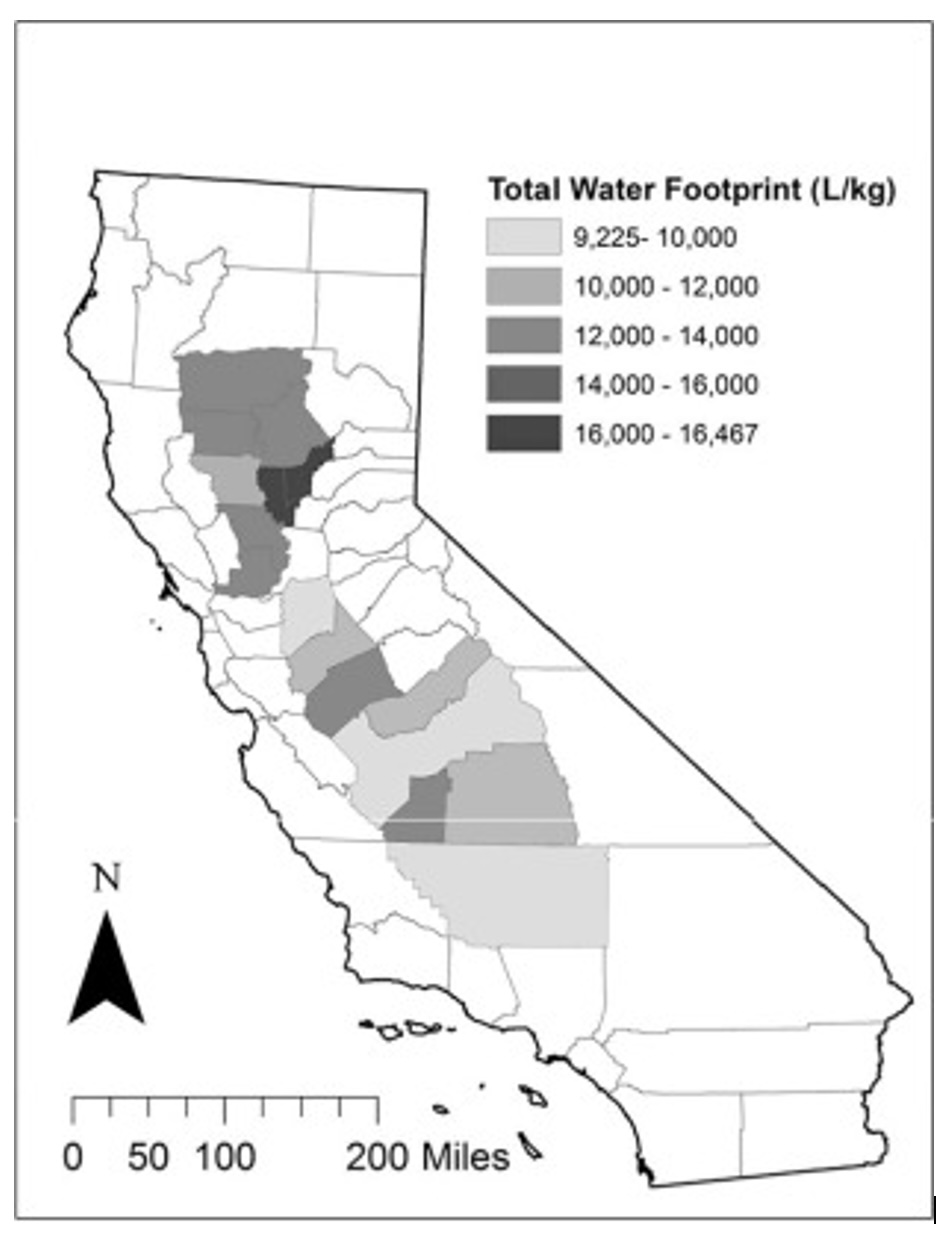
City dwellers in California are routinely told they are the problem for overusing water, but over 80% of water use in the state is for agriculture. The biggest crop in California is nuts. The California desert is ideal for growing crops “out of season.” I want my nuts all year round!
The water footprint of California almonds averaged 10,240 liters per kilogram kernels (or, 12 liters per almond kernel) ... In relation to dietary benefits, almonds were among the top three foods analyzed providing the greatest nutritional benefit per unit weights, however they had the highest water footprint value per unit weight. The direct economic benefits of almond production based on market sales were also greater than for any other major crop in California, however almonds again had the largest water footprint on a per-unit and aggregate basis.”
Bernhardt is no longer a government official, but Trump’s second-term Vice President, JD Vance, has gotten involved with the trading of water and farmland through a company called AcreTrader:
Some of the most pristine farmland in California can be yours, at least by proxy, in just a matter of minutes. That’s the promise that AcreTrader, a company with the mission of simplifying investing in valuable U.S. farmland, makes to prospective financiers.
Its current offerings include 83 acres of almond trees in the San Joaquin Valley, advertised as “an opportunity to invest in a water-secure almond orchard in the world’s most productive almond-producing region.” This property also boasts of senior water rights on the Kings River, suggesting that the land will continue to turn a profit long into the future — a dream of farmers and investors alike.
AcreTrader is just one of many companies launched in the past decade that facilitate the sale of farmland, which has increasingly become a staple in investor portfolios. Recently, it was revealed that this includes the investment portfolio of Vice Presidential nominee JD Vance, the Republican senator from Ohio.
“There’s no indication that Vance has divested from AcreTrader, and there’s every indication that that investment remains in place.”
In a social media post, Sarah Taber, a farm and food systems strategist and the Democratic candidate for North Carolina commissioner of agriculture, describes AcreTrader as “like Uber for buying U.S. farmland.” Like Uber, AcreTrader makes it easier for more buyers to gain quick access to an ordinarily expensive asset. “And who’s one of its key investors, profiting off of every sale?” Taber asks. “JD Vance.”
Bernhardt and Vance personify bullying. The bully’s phrase that comes to my mind is “What are you going to do about it, huh?”
Maybe I don’t want to support these bullies by purchasing California almonds. I could buy cashews instead! But the harvesting and processing of cashews is linked with environmental destruction and human rights violations. Primary producers of cashews include Ivory Coast, India, Vietnam, Indonesia, and the Philippines, hardly paragons of human and environmental rights. Cashews belong to the poison ivy family and cannot be eaten from the shell because they contain a toxic resin.
The nuts – 60 per cent of which are processed in India – are exceptionally hard to extract. A cashew has two layers of hard shell between which are caustic substances – cardol and anacardic acid – which can cause vicious burns.
Many of the women who work in the cashew industry have permanent damage to their hands from this corrosive liquid, because factories do not routinely provide gloves. For their pains they earn about 160 rupees for a 10-hour day: £1.70.
Conditions in Vietnam may be even worse than in India. Cashews are sometimes shelled by drug addicts in forced labor camps, who are beaten and subjected to electric shocks. Time magazine has described this trade as “blood cashews.”
Among the “clean eaters” of this world, unsalted cashews are a staple, whizzed up into milks and butters. Last year The American Journal of Clinical Nutrition looked at the links between nut consumption – including cashews – and chronic disease. High nut intake – including cashews – was linked to lower rates of heart disease and “all-cause mortality”.
The cashew offers many benefits. The shell of its seed has compounds that can be used to make lubricants, waterproofing, and paints. The cashew apple can be processed into a fruit drink or distilled into liquor. Further, cashew products can activate the immune system and fight cancer.
The cashew is native to Brazil, but its ubiquity comes from colonialism. The Portuguese brought plants to Goa, India, in the mid-1500s, and plants were later grown in Southeast Asia and Africa. “The original word is acaju (meaning the ‘nut that produces itself’), which comes from the language of the Tupian people who live in northeast Brazil where cashew trees originate.” The US Consumes 90% of the World’s cashews. Half the world’s cashews are sold by Costco. 27% of the market share of cashews is held by Planters. I can decide not to eat cashews – thereby losing the health benefits.
Pattern Recognition across Problem and Discipline
- The shell of the nut and Schwitters’ collages create contained spaces.
- Cashew shells contain an acid that burn and injure the workers who shell them. The shells used by military forces burn and injure their victims.
- “Gang” means assemblage.
- The apparent order of Mr. Peanut creates a contrast with the apparent chaos of Schwitters’ work.
- Mr. Peanut is human size man, while the size of an actual peanut is small. Hitler had relatively small stature, but his grandiosity was outsized.
- The peanut is not actually a nut but a legume. “Le’ go me!” is what you say to a bully.
- Mr. Peanut wears a monocle lens. Lens is linked etymologically to lentil. Lentils are legumes. Lenses were critical to the Hitler regime, particularly those used by Leni Reifenstahl, Hitler’s favorite filmmaker.
- In terms of nuttiness, Planters is more like Elon Musk (upper left of our chart) than like Jim Jones (or Hitler) (lower left).
Divining the Widesite
The nut is an aporia. Nut production is water intensive and labor intensive and is largely run by bullies who exploit workers and the environment. But nuts pack a lot of nutrition in their small size, and the plants, such as the cashew, are valuable for their industrial and medical benefits. Is there a way to get the benefits of nuts without the suffering involved in their production?
The question reminds me of Freud’s theory of the artist. Artists, in Freud’s view, were creative because they suffered from unresolved neuroses and sublimated their desires in their art. Freud saw art as beneficial but believed that its production was rooted in suffering. By Freud’s logic, if the artist resolved their neuroses they would lose their creativity. Sheldon Litt challenges Freud’s theory in his paper, “The Origins of Creativity: Sexuality, Neurosis, and the Artist,” and argues that art arises fundamentally from a healthy impulse to be “procreative” and “symbolically creative.” He offers his own tentative definition of art: “art is the admiring exploration and manipulation of the environment.” But the word “admiring” seems to mark exclusivities since it excludes art that is a despairing exploration and manipulation of the environment.
Our current economic system, the one that supplies me with nutritious nuts, depends on mass acquiescence to what Gandhi called “passive violence,” built upon “Seven Blunders.”
A few weeks before he was assassinated, Gandhi the Mahatma had a conversation with his grandson Arun. He handed Arun a talisman upon which were engraved “Seven Blunders,” out of which, said Gandhi, grows the violence that plagues the world. The blunders were:
Wealth without work.
Pleasure without conscience.
Knowledge without character.
Commerce without morality.
Science without humanity.
Worship without sacrifice.
Politics without principles.Gandhi called these disbalances “passive violence,” which fuels the active violence of crime, rebellion, and war. He said, “We could work ’til doomsday to achieve peace and would get nowhere as long as we ignore passive violence in our world.”
To his grandfather’s list of seven blunders Arun later added an eighth: Rights without responsibilities.
Gandhi gave the list to Arun in 1947. Almost fifty years later the blunders have been institutionalized, built into our corporations, our governments, our very culture. Not only are we no longer embarrassed by them; we actively practice them. In some of them we even take pride. From Wall Street to state lotteries, we entice ourselves with the promise of wealth without work. Whole sectors of the economy offer pleasure without conscience.
Most people are probably unaware that their consumption of nuts constitutes passive violence. I am aware of it, and I continue to eat nuts. Why? Because almost every food product that is mass marketed involves some form of passive violence. I can seek out more ethical food options. But such acts seem insufficient because my own “purity” has little impact at global scale.
What are you going to do about it, huh?
Fact: There are bullies. And they have inordinate control over the economy, the environment, and many major institutions.
Feeling: Shame and rage. It is easy to feel impotent against the bullies and their destruction, to feel like “a little piece of filth.”
What is to be done: In a world gone nuts, go nuts! I am reminded of Anna Freud Banana, who reached the same conclusion. In a world gone bananas, she went bananas. But in the right way – pro-social. Also, only go half nuts! Going all-the-way nuts does not offer a lot of advantages. What does it mean to go half nuts? It means to persist in dwelling, whether to do so is admiring or despairing. It means to build one’s environment, even if, like Kurt Schwitters, the only materials you have are porridge and cut linoleum. It means to support one’s children through the catastrophe of overshoot, but to teach them Gandhi’s wisdom.
From shame to shaman: Shame is a form of madness, a disorder in which the sufferer is possessed by a sense of worthlessness. The shaman is half nuts. Elliade and Harry Eiss state that the Shaman is “in control of the mystic state, rather than the psychotic state being in control of him.”
Robert Sapolsky writes:
In the 1930s an anthropologist named Paul Radin first described it as “shamans being half mad,” shamans being “healed madmen.” This fits exactly. It’s the shamans who are moving separate from everyone else, living alone, who talk with the dead, who speak in tongues, who go out with the full moon and turn into a hyena overnight, and that sort of stuff. It’s the shamans who have all this metamagical thinking. When you look at traditional human society, they all have shamans. What’s very clear, though, is they all have a limit on the number of shamans. That is this classic sort of balanced selection of evolution. There is a need for this subtype, but not too many.
The critical thing with schizotypal shamanism is, it is not uncontrolled the way it is in the schizophrenic. This is not somebody babbling in tongues all the time in the middle of the hunt. This is someone babbling during the right ceremony. This is not somebody hearing voices all the time, this is somebody hearing voices only at the right point. It’s a milder, more controlled version.
Shamans are not evolutionarily unfit. Shamans are not leaving fewer copies of their genes. These are some of the most powerful, honored members of society. This is where the selection is coming from. What this shamanistic theory says is, it’s not schizophrenia that’s evolved, it’s schizotypal shamanism that’s evolved. In order to have a couple of shamans on hand in your group, you’re willing to put up with the occasional third cousin who’s schizophrenic. That’s the argument; and it’s a very convincing one.
We need more nuts! But it matters a great deal what kinds of nuts. We need nuts who can balance striving and nurturing, who can be in control of their madness, who can channel it into creative endeavors, who can admiringly or despairingly explore and manipulate the environment. We need nuts who will serve as donors, teaching us to avoid the Seven Blunders (as well as the eighth). We need to integrate such shamanic nuts into our institutions, to help guide research, teaching, invention, and judgment. But we have new methods of producing nuts that don’t require actual madness. Now we can simulate madness, controlling it more effectively.
Avant-garde movements, such as the Dadaists, Surrealists, and Fluxists, used method to produce their madness. Theorists such as Gilles Deleuze have articulated the methods of simulating madness so that we can have the benefits of it without the downsides. Theory and the avant-garde give us method to our madness, and we learn from them how to be appropriately half nuts.
Works Cited
“Cashew Market Size, Share, Growth, and Industry Analysis, By Types (Flavoured, Unflavoured), Applications (Daily Food, Cooking, Others) and Regional Insights and Forecast to 2033.” Global Growth Insights. May 19, 2025. globalgrowthinsights.com/market-reports/cashew-market-114174
“Everything You Need to Know about COP.” Global Witness. September 6, 2024. globalwitness.org/en/campaigns/fossil-fuels/everything-you-need-to-know-about-cop/
“Statement on criminal referral of David Bernhardt for likely quid pro quo in Arizona.” Center for Western Priorities. May 11, 2022. westernpriorities.org/2022/05/statement-on-criminal-referral-of-david-bernhardt-for-likely-quid-pro-quo-in-arizona/
“Statement on IG investigation into David Bernhardt’s work for Westlands Water District.” Center for Western Priorities. January 19, 2023. westernpriorities.org/2023/01/statement-on-ig-investigation-into-david-bernhardts-work-for-westlands-water-district/
“Turning the Tide: A Call to Collective Action by the Global Commission on the Economics of Water.” turningthetide.watercommission.org/
Davenport, Coral. “Trump’s Pick for Interior Dept. Continued Lobbying After Officially Vowing to Stop, New Files Show.” New York Times. April 4, 2019. nytimes.com/2019/04/04/climate/david-bernhardt-interior-lobbying.html
Deleuze, Gilles. The Logic of Sense. trans. Mark Lester (New York: Columbia University Press, 1990).
Ecological Indicators, Volume 96, Part 1, 2019, pp. 711-717.
Eiss, Harry. Divine Madness. Cambridge Scholars Publishing, 2011. pp. 372–374.
Elizur A, Appel MY, Nachshon L, et al. “Cashew oral immunotherapy for desensitizing cashew-pistachio allergy (NUT CRACKER study).” Allergy. 2022;77:1863–1872. doi:10.1111/all.15212.
Enderfield, John. “The Early Works of Kurt Schwitters.” Artforum. November 1971. artforum.com/features/the-early-work-of-kurt-schwitters-213210/
Ernst Schwitters’ letter in Art and News Review, Saturday 25 October 1958, Vol X, No. 20, p. 8.
Freud, Sigmund. Introductory Lectures on Psychoanalysis. (1915) London: Hogarth Press, 1959; SE 15.
Fulton, Julian, Michael Norton, and Fraser Shilling. “Water-Indexed Benefits and Impacts of California Almonds.”
Greimas, Algirdas Julien. 1973. “Actants, Actors, and Figures.” On Meaning: Selected Writings in Semiotic Theory. Trans. Paul J. Perron and Frank H, Collins. Theory and History of Literature, 38. Minneapolis: U of Minnesota P, 1987. 106–120.
Klein, Naomi and Astra Taylor. “The Rise of End Times Fascism.” The Guardian. April 13, 2025. theguardian.com/us-news/ng-interactive/2025/apr/13/end-times-fascism-far-right-trump-musk
Kotler, Philip and Christian Sarkar. Wicked Problems: What Can We Do in this Time of Collapse? Idea Bite Press. 2025.
Leiris, Michel. “The Sacred in Everyday Life.” Ed. Denis Hollier. The College of Sociology (1937-39). Minneapolis: University of Minnesota Press, 1988.
Levin, Kelly, et al. “Overcoming the Tragedy of Super Wicked Problems: Constraining Our Future Selves to Ameliorate Global Climate Change.” Policy Sciences, vol. 45, no. 2, 2012, pp. 123–52. JSTOR, jstor.org/stable/41486859. Accessed 31 May 2025.
Litt, Sheldon. “The Origins of Creativity: Sexuality, Neurosis and the Artist.” International Forum of Psychoanalysis, 4:97-103. bgsp.edu/app/uploads/2014/12/Litt-The-Origins-of-Creativity.pdf
Meadows, Donella. “Gandhi’s Seven Blunders–And Then Some.” The Donella Meadows Project: Academy for Systems Change. August 18, 1994. donellameadows.org/archives/ghandis-seven-blunders-and-then-some/
Moran, Grey. “JD Vance Funded AcreTrader. Here’s Why That Matters.” Civil Eats. September 18, 2024. civileats.com/2024/09/18/jd-vance-invested-in-acretrader-heres-why-that-matters/
Oliveira, Rosane. “Cashew: The Nut That Is Not a Nut.” November 19, 2017. pblife.org/nutrition/cashew-not-nut/
Rickels, Lawrence. The Case of California. Johns Hopkins University Press, 1991.
Rittel, Horst W.J., Melvin M. Webber. “Dilemmas in a General Theory of Planning.” Policy Sci 4, 1973. 155–169. doi:10.1007/BF01405730.
Saper, Craig. “The Banana Paradox.” In Jacques, Michelle (ed.) (Ed.), Anna Banana: 45 Years of Fooling Around with A. Banana (pp. 58-71). Vancouver and Victoria, BC: Figure 1 Publishing and Art Gallery of Greater Victoria. 2015.
Sapolsky, Robert. “Belief and Biology.” Freedom from Religion Foundation. April 2003. ffrf.org/fttoday/april-2003/articles-april-2003/belief-and-biology/
Schwartz, Jerry. “His Little Mount Fuji Wealth of Memories.” Miami Herald, November 1, 1974. assets.speakcdn.com/assets/2845/srp_oct_1977.pdf
Snell, Geoff. “Part 4: Kurt Schwitters (1887-1948).” drgeoffsnell.com/2018/07/04/the-doctors-dozen-kurt-schwitters/
Ulmer, Gregory. “The Learning Screen from Networked Book.” www. academia.edu, academia.edu/37590082/The_Learning_ Screen_From_Networked_Book
Ulmer, Gregory. “The Sweet Spot of American Values.” kairos.technorhetoric.net/stasis/2023/ulmer/diagrams/sweet.html
Ulmer, Gregory. Internet Invention. Longman. 2003, 4.
Ulmer, Gregory. Konsult: Theopraxesis. Parlor Press, 2019.
Wilson, Bee. “Blood Cashews”: The Toxic Truth about Your Favourite Nut.” The Telegraph. May 4, 2015. telegraph.co.uk/foodanddrink/foodanddrinknews/11577928/Blood-cashews-the-toxic-truth-about-your-favourite-nut.html
Notes
- kairos.technorhetoric.net/stasis/2023/ulmer/diagrams/sweet.html
- Levin, Kelly, et al. “Overcoming the Tragedy of Super Wicked Problems: Constraining Our Future Selves to Ameliorate Global Climate Change.” Policy Sciences, vol. 45, no. 2, 2012, pp. 123–52. JSTOR, http://www.jstor.org/stable/41486859. Accessed 31 May 2025.
- Philip Kotler and Christian Sarkar. Wicked Problems: What Can We Do in this Time of Collapse? Idea Bite Press. 2025.
- Gregory Ulmer. “The Learning Screen from Networked Book.” academia.edu/37590082/The_Learning_ Screen_From_Networked_Book
- Gregory Ulmer. Internet Invention. Longman. 2003, 4.
- Naomi Klein and Astra Taylor. “The Rise of End Times Fascism.” The Guardian. April 13, 2025. theguardian.com/us-news/ng-interactive/2025/apr/13/end-times-fascism-far-right-trump-musk
- Center for Western Priorities. “Statement on IG investigation into David Bernhardt’s work for Westlands Water District.” January 19, 2023. westernpriorities.org/2023/01/statement-on-ig-investigation-into-david-bernhardts-work-for-westlands-water-district/
- Coral Davenport. “Trump’s Pick for Interior Dept. Continued Lobbying After Officially Vowing to Stop, New Files Show.” New York Times. April 4, 2019. nytimes.com/2019/04/04/climate/david-bernhardt-interior-lobbying.html
- Rittel, Horst W.J., Melvin M. Webber. “Dilemmas in a General Theory of Planning.” Policy Sci 4, 1973. 155–169. doi:10.1007/BF01405730
- “Everything You Need to Know about COP.” Global Witness. September 6, 2024. globalwitness.org/en/campaigns/fossil-fuels/everything-you-need-to-know-about-cop/
- Ulmer. Konsult: Theopraxesis. Parlor Press, 2019.
- Michel Leiris. “The Sacred in Everyday Life.” The College of Sociology (1937-1939). Ed. Denis Hollier. University of Minnesota Press, 1988. Page 24.
- Leiris, Michel. “The Sacred in Everyday Life.” Ed. Denis Hollier. The College of Sociology (1937-39). Minneapolis: University of Minnesota Press, 1988.
- In graduate school, I read Lawrence Rickel’s The Case of California, about how horizontal associations were replacing vertical ones. In other words, kids were identifying with each other rather than with adult authority figures. The result was the suicide cult.
- When I imagine an afterlife now, I ask, “what about all the people who have annoyed me? Why should the afterlife only include loved ones?”
- See Julien Greimas’ Actantial Model for an explanation of these roles. Greimas, Algirdas Julien. 1973. “Actants, Actors, and Figures.” On Meaning: Selected Writings in Semiotic Theory. Trans. Paul J. Perron and Frank H, Collins. Theory and History of Literature, 38. Minneapolis: U of Minnesota P, 1987. 106–120.
- From the Miami Herald, 1 November. 1974, assets.speakcdn.com/assets/2845/srp_oct_1977.pdf
- Geoff Snell. “Part 4: Kurt Schwitters (1887-1948).” drgeoffsnell.com/2018/07/04/the-doctors-dozen-kurt-schwitters/
- Ernst Schwitters’ letter in Art and News Review, Saturday 25 October 1958, Vol X, No. 20, p. 8.
- John Enderfield. “The Early Works of Kurt Schwitters.” Artforum. November 1971. artforum.com/features/the-early-work-of-kurt-schwitters-213210/
- “Turning the Tide: A Call to Collective Action by the Global Commission on the Economics of Water.” turningthetide.watercommission.org/
- Coral Davenport. “Trump’s Pick for Interior Dept. Continued Lobbying After Officially Vowing to Stop, New Files Indicate.” April 4, 2019. nytimes.com/2019/04/04/climate/david-bernhardt-interior-lobbying.html
- “Statement on criminal referral of David Bernhardt for likely quid pro quo in Arizona.” Center for Western Priorities. May 11, 2022. westernpriorities.org/2022/05/statement-on-criminal-referral-of-david-bernhardt-for-likely-quid-pro-quo-in-arizona/
- Julian Fulton, Michael Norton, Fraser Shilling. “Water-Indexed Benefits and Impacts of California Almonds.” Ecological Indicators, Volume 96, Part 1, 2019, pp. 711-717.
- Grey Moran. “JD Vance Funded AcreTrader. Here’s Why That Matters.” civileats.com/2024/09/18/jd-vance-invested-in-acretrader-heres-why-that-matters/ Civil Eats. September 18, 2024
- Bee Wilson. “‘Blood cashews’: the toxic truth about your favourite nut.” The Telegraph. May 4, 2015. telegraph.co.uk/foodanddrink/foodanddrinknews/11577928/Blood-cashews-the-toxic-truth-about-your-favourite-nut.html
- Elizur A, Appel MY, Nachshon L, Levy MB, Epstein-Rigbi N, Koren Y, Holmqvist M, Porsch H, Lidholm J, Goldberg MR. “Cashew Oral Immunotherapy for Desensitizing Cashew-Pistachio Allergy (NUT CRACKER study).” Allergy. 2022 Jun;77(6):1863-1872. doi:10.1111/all.15212.
- Rosane Oliveira. “Cashew: The Nut That Is Not a Nut.” November 19, 2017. pblife.org/nutrition/cashew-not-nut/
- “Cashew Market Size, Share, Growth, and Industry Analysis, By Types (Flavoured, Unflavoured), Applications (Daily Food, Cooking, Others) and Regional Insights and Forecast to 2033.” Global Growth Insights. May 19, 2025. globalgrowthinsights.com/market-reports/cashew-market-114174
- Sigmund Freud. Introductory Lectures on Psychoanalysis. (1915) London: Hogarth Press, 1959; SE 15.
- Sheldon Litt. “The Origins of Creativity: Sexuality, Neurosis and the Artist.” International Forum of Psychoanalysis, 4:97-103. bgsp.edu/app/uploads/2014/12/Litt-The-Origins-of-Creativity.pdf
- Donella Meadows. “Gandhi’s Seven Blunders–And Then Some.” The Donella Meadows Project: Academy for Systems Change. August 18, 1994. donellameadows.org/archives/ghandis-seven-blunders-and-then-some/
- Craig Saper. “The Banana Paradox.” In Jacques, Michelle (ed.) (Ed.), Anna Banana: 45 Years of Fooling Around with A. Banana (pp. 58-71). Vancouver and Victoria, BC: Figure 1 Publishing and Art Gallery of Greater Victoria. 2015.
- Harry Eiss (2011). Divine Madness. Cambridge Scholars Publishing. pp. 372–374.
- Robert Sapolsky. “Belief and Biology.” Freedom from Religion Foundation. April 2003. ffrf.org/fttoday/april-2003/articles-april-2003/belief-and-biology/
- Gilles Deleuze. The Logic of Sense. trans. Mark Lester (New York: Columbia University Press, 1990.