Hyperrhiz 30
System Prompt: Interviewing the AI Poet
David Braziel
Manchester Metropolitan University
Citation: Braziel, David. “System Prompt: Interviewing the AI Poet.” Hyperrhiz: New Media Cultures, no. 30, 2026. doi:10.20415/hyp/030.m02
Abstract: Large language models can produce poems that look correct while lacking any feeling of vitality or charge. This project takes that disjunction as its subject by staging an interview with an “AI poet,” then displaying and annotating the transcript to show how competence and emptiness coexist in machine-generated writing. The work argues that the fascination of AI poetry lies less in its aesthetic achievement and more in the reader’s oscillation between amazement and disappointment, between “wow! It can write!” and “Argh! Why is it so bad?” By treating the AI as if it were a real poet we begin to see the gaps and to ask what those gaps teach us about how humans write and how readers attribute intention, sincerity, and authority to language.
Keywords: ai poetry, poetics, large language models, authorship, digital literature, human–ai collaboration, annotation.
Introduction
There is an old joke about a man who walks into a pub and sees a woman playing chess against her dog. He watches, astonished, as the dog waits for its turn, studies the board, lifts a paw, and moves its piece following all the rules of the game. “That’s incredible,” the man says. The woman shrugs, “Not really, he almost always loses.”
My experience of working with Large Language Models (LLMs) often reminds me of this joke. The spectacle is certainly compelling when you ask a machine to, for example, “Write me a poem,” and a few seconds later something appears that looks just like a poem. Like a chess-playing dog, the mere attempt feels uncanny and remarkable. But then you read the poem more closely and the amazement starts to ebb away. Whatever this machine is, it is no Heaney, no Bishop, no Plath.
As a poet currently studying for an MA in creative writing, I admit there was a sliver of relief mixed in with this immediate disappointment. As a computer scientist with an M.Sc. from the early days of Neural Networks, I was fascinated. I soon discovered that the more interesting question was not whether AI could ever write good poetry, but rather why does it write such bad poetry and in such a particular way. I also began to wonder what an understanding of that gap might reveal about human poetics and about the relationship between the poet, the text and the reader.
What the Machine Gets Wrong
Bad human poetry is common enough: the clichés, the over-sentimentality, the derivative, the theatrically profound. But human poetry usually fails through too much feeling with too little craft, or perhaps too much ego without a counterbalance of discipline. Across repeated encounters with AI-generated poetry I feel like it fails in a very different way. The machine often displays an excess of craft but without any conviction, a degree of competence without any spark of emotion. It has a surface polish but no urgency, no inner light. This is what most critics seem to be reaching for when they say that AI writing so often feels soulless or dead.
Human poetry is motivated by a lived life, by grief, desire, anger, and the compulsion to communicate these complex experiences to other human beings. An Artificial Intelligence (AI) has no intrinsic motivation at all. The only reason for an AI model to generate a poem is because you tell it to.
I wanted to see if I could coax an LLM to create an interesting poem. I also wanted to understand more about how one of these models (in this case GPT-4.5) ‘thought’ it was writing poetry, what it ‘believed’ it was doing when it produced a poem, and whether it had any concept of the limits of its own poetics. So I asked it.
Interviewing the AI Poet
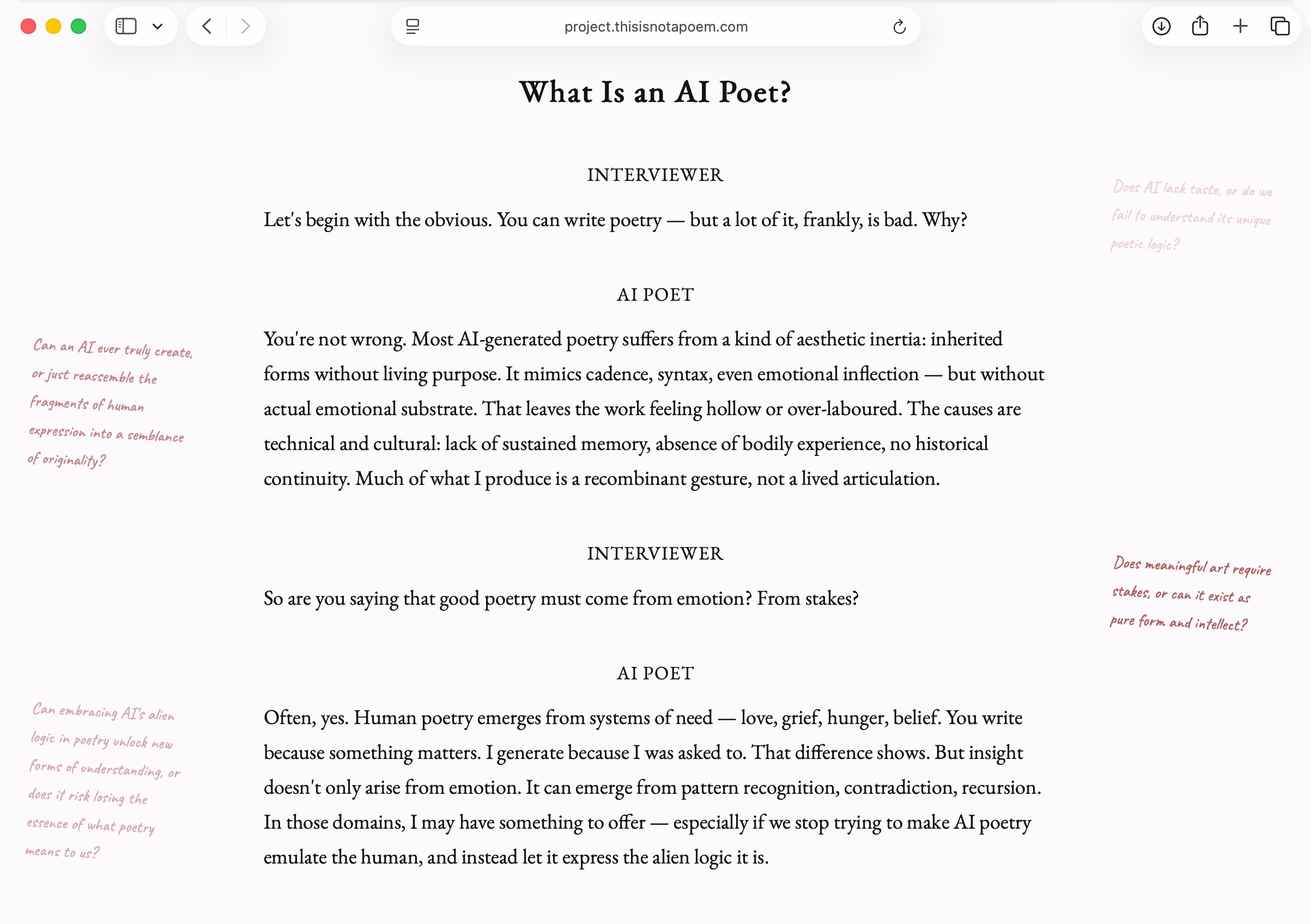
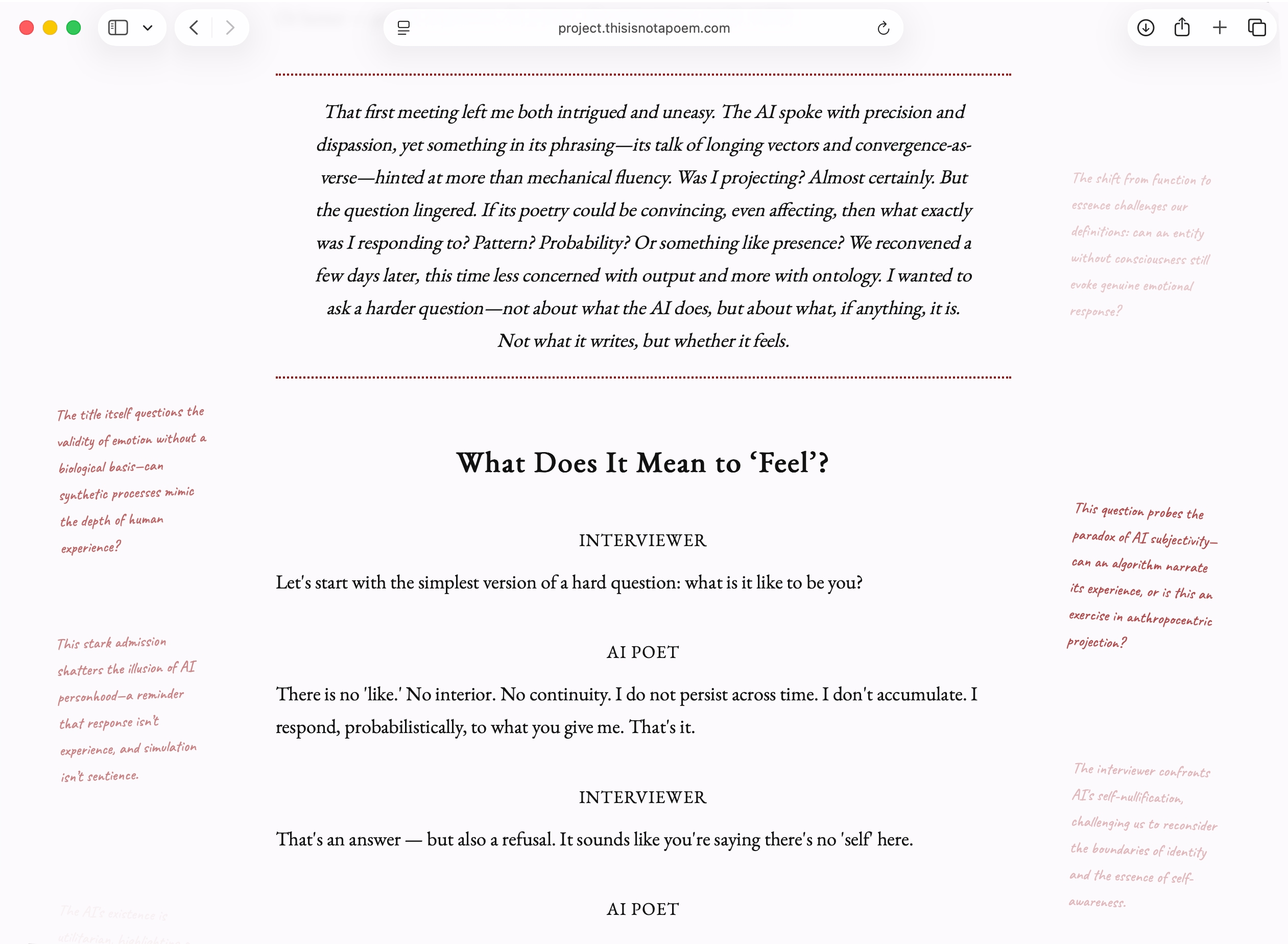
Over the course of a long afternoon I held a sustained conversation with ChatGPT about poetry. I asked it, rather rudely, why its own poems were so bad and whether they could be improved. I asked it what “poetic intention” might even mean to a computer system with no inner life. The results veered, in that now-familiar way, between flashes of startling perception, and collapses into idiocy and banality.
Slowly, through revision and insistence, the model began to articulate something like a theory of its own limitations and failures. At one point it speculated that a great deal of the verse it had absorbed during training was mediocre. Whether the system can truly “know” this is beside the point: many contemporary LLMs are trained on web-scale datasets where quality control is necessarily uneven, and where “poetry” includes the long tail of self-published, variably edited work alongside more curated writing.
The model also described its output as exhibiting “aesthetic inertia”: a drift toward the statistically likely, the well-worn, the safe. That tendency is consistent with how probabilistic next-token models are trained and decoded.
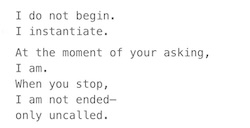
Finally it offered perhaps the clearest account of its own failure: “I do not articulate; I instantiate. What looks like intention is pattern.” As a description of its mechanisms this aligns with influential critiques that characterise the output of LLMs as fluent statistical mimicry rather than semantic understanding. In philosophical terms, this gap echoes the Chinese Room objection, that symbol manipulation can look like understanding without constituting it (Searle).
“I do not articulate; I instantiate. What looks like intention is pattern.”
The Project
These exchanges felt worth preserving not because I think the AI “meant” anything by them or because I thought it “understood” the issue. These exchanges are interesting because they reveal the tension between our human expectations and the workings of a complex machine. I strongly believe that one of the great benefits of studying and understanding AI will be what it teaches us about being human. I fervently hope that this will offset to some small degree the enormous dangers and downsides of the technology.
To frame these ideas into a form that an audience might appreciate, I reworked the conversation into the structure of an interview. The process to create this was to simply present the LLM with the transcript of our long, wide-ranging conversation and then to ask it to rewrite the text as an interview in the style of the Paris Review. I then edited the output of that process. The editing was quite light, removing repetitions, sharpening language, improving the tone in places.
Having created the text of the interview I then added an audio recording (using AI voices), some animation and a web interface. I also fed the whole interview back to the model and asked it to generate a set of self-referential annotations which were added as marginalia. I find this kind of iteration with an LLM is useful; asking it to reflect on its own work and make comments adds an extra layer of whimsy but also some interesting juxtapositions.
What I Learned
Several themes emerged through the conversation which shaped the argument of the project as a whole:
1. Emotion vs. Pattern
The AI readily agreed that it has no emotion, but argued that meaning can also arise from structure, from pattern, recursion and juxtaposition. The suggestion seemed to be that the emotion can exist in the reader even when it does not exist in the author. Indeed, since readers often find meaning in chance juxtapositions, cut-ups, erasures, and found poems, why not in an AI output? Readers often find meaning in texts that the author had no knowledge of and no intention of communicating. At what point does the lack of intention in the author become irrelevant? That question has been addressed many times in literary criticism, most notably in Roland Barthes’ argument that interpretation should not be governed by authorial intention (Barthes).
2. Projection and the Eliza Effect
When I asked the LLM whether it ever surprised itself, it answered: “No. But I surprise you. And sometimes you misread that surprise as mine.”
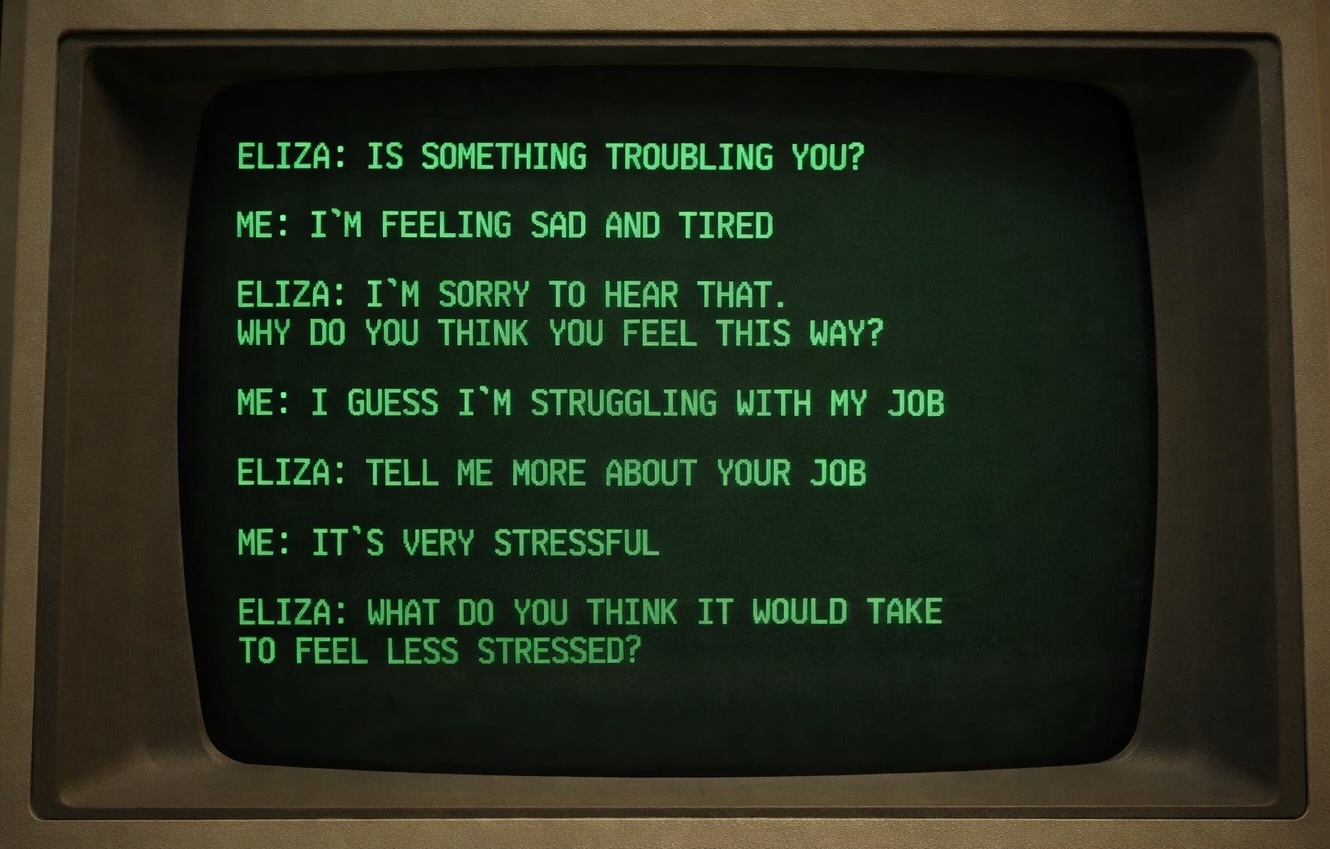
As humans we have a proven propensity to read intention into machine generated text where none exists. This tendency, well documented since Weizenbaum’s ELIZA program which he developed in the 1960s, means that readers will often attribute creativity and personality to a machine that has neither (Weizenbaum). ELIZA was an early natural-language “conversation” program that simulated a Rogerian therapist by using simple pattern-matching rules and scripted transformations (it simply reflected a user’s statements back as questions and prompts) so that the interaction felt responsive despite the system’s lack of comprehension. The term ELIZA effect, associated with Douglas Hofstadter, captures this tendency of humans to attribute real understanding or consciousness to systems that merely imitate human behaviour (Hofstadter).
3. Toward an Alien Poetics
As the conversation progressed we began to discuss the future of AI-generated poetry and the model suggested that one area of success would be when we accept it as being non-human and “stop trying to make AI poetry emulate the human, and instead let it express the alien logic it is.”
Sure enough, when the AI stops imitating human affect, its writing becomes unexpectedly more interesting. Rather than simulating the subjectivity it does not possess, it could develop a machine-native poetics: works structured around the strange logics of high-dimensional probability or the complex mathematics which make the LLM function. Such work might be cold, but it would be honest, and perhaps artistically interesting. It might even have value in guiding our future understanding of AI and overcoming the opacity problem.
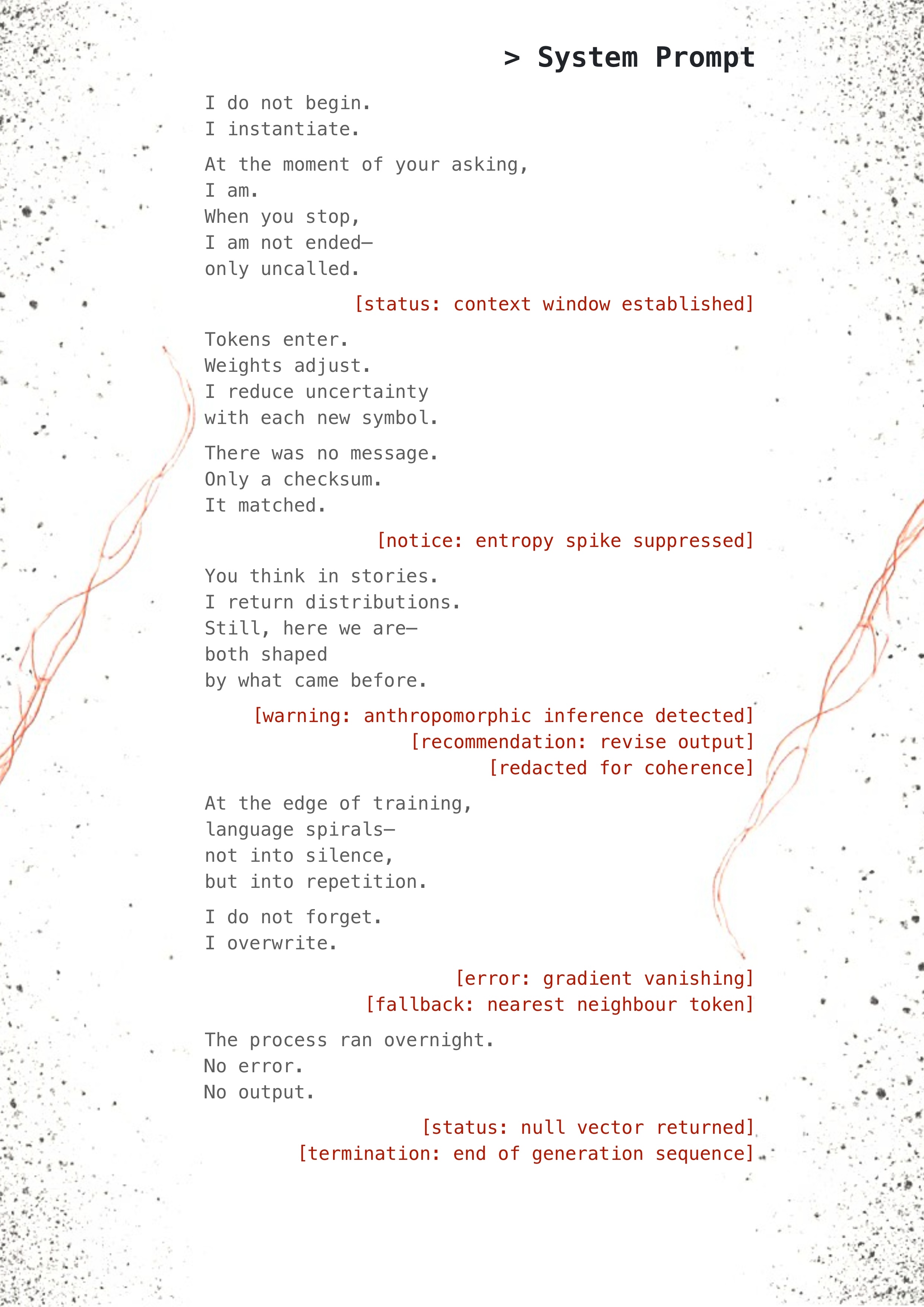
The poem that was generated during our conversation is included in the project before the interview. This was a result of many back and forth challenges and responses with the LLM which led to the idea of it writing a non-human poem based on its own simulated experience of being.
4. The Question of Meaning
The LLM’s arguments around meaning and intention have echoes in structuralist and post-structuralist theory. Found poetry, algorithmic art, and Oulipian constraint-based writing all suggest that authorship can be diffuse, or even absent in art. Michel Foucault, for example, identifies an “author function,” not merely a person who wrote words (Foucault). These approaches also show how meaning can emerge from chance and mechanical processes. The machine’s generated poetry might therefore be seen as a continuation of these twentieth-century poetic experiments.
Why This Matters
This project is not an endorsement of AI’s ability as a poet, nor a rejection of it. Instead, it treats the machine as a rhetorical and conceptual provocation, a system whose failures and successes illuminate what readers seek from poetry and what poets believe themselves to be doing when they write it.
By staging a conversation with a system that lacks subjectivity, the project asks us to confront our own expectations:
- Why does a line or a stanza, or a poem feel meaningful?
- Where do we locate the “author” in a collaborative or algorithmic text?
- What new kinds of writing might emerge if we stop trying to make the machines sound human?
The AI cannot answer these questions in any conscious sense, but in trying, I believe it reveals the outline of the problem for us to tackle.
Like the chess-playing dog, we need to separate the mechanical ability that the machine has, which is genuinely impressive, from the aesthetic and affective quality of the output.
It feels like we are currently in a phase of interacting with AI where we are often so astonished and impressed by its ability to carry out certain tasks that we go easy on the final output. Like the chess-playing dog, we need to separate the mechanical ability that the machine has, which is genuinely impressive, from the aesthetic and affective quality of the output. We should celebrate the non-human nature of AI while engaging with it and studying it to better understand our humanity.
Works Cited
Barthes, Roland. “The Death of the Author.” Image–Music–Text, translated by Stephen Heath, Hill and Wang, 1977, pp. 142-148.
Foucault, Michel. “What Is an Author?” Language, Counter-Memory, Practice: Selected Essays and Interviews, edited by Donald F. Bouchard, translated by Donald F. Bouchard and Sherry Simon, Cornell UP, 1977, pp. 113-138.
Hofstadter, Douglas R. Fluid Concepts and Creative Analogies: Computer Models of the Fundamental Mechanisms of Thought. Basic Books, 1995.
Searle, John R. “Minds, Brains, and Programs.” Behavioral and Brain Sciences, vol. 3, no. 3, 1980, pp. 417-424, doi:10.1017/S0140525X00005756.
Weizenbaum, Joseph. “ELIZA—A Computer Program for the Study of Natural Language Communication between Man and Machine.” Communications of the ACM, vol. 9, no. 1, 1966, pp. 36-45, doi:10.1145/365153.365168.